


Let’s talk tattoos—not your usual Pinterest inspo or midlife crisis ink, but a hidden queer history etched quietly into skin, defying a world that refused to see it. This isn’t just about a cool design or old-school sailor vibes. It’s about a small, five-pointed star that lit the way for an entire generation of women looking for connection, identity, and safety. Today, we’re unpacking the beautiful and quietly radical meaning behind the nautical star tattoo among lesbians in the 1940s and 50s—and trust me, it’s worth knowing.
Picture it: the 1940s. Wartime’s just passed, society is rigid, conservative, and deeply homophobic. There’s no Pride, no safe bars lit up in rainbow neon, no social media hashtags to find your people. For lesbians, living openly wasn’t just frowned upon—it was dangerous. Being out could cost you your job, your home, your freedom. But humans are wired for connection, and where there’s repression, there’s resistance. And sometimes that resistance shows up as a star.

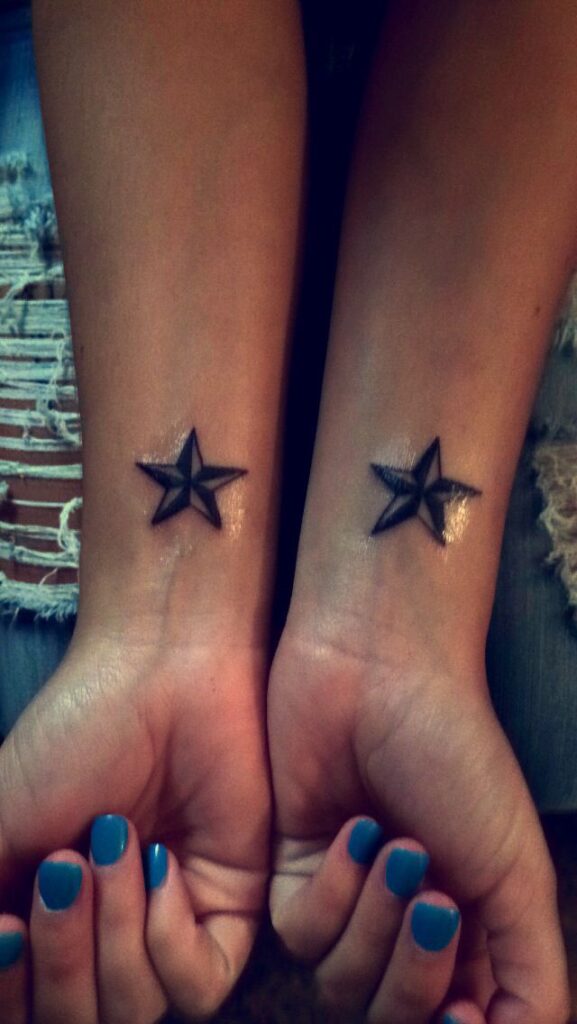
The nautical star, traditionally used by sailors as a symbol of direction and safe return, became a quiet rallying point in the lesbian community. A subtle marker. A soft rebellion. Inked most often on the wrist—just beneath a watch strap—it could be hidden in plain sight. You’d never know unless you knew. And if you did know, it spoke volumes.
These tattoos weren’t random. They were carefully chosen, purposefully placed, and deeply personal. They were like a secret handshake—a way for queer women to recognise one another in a time when simply being yourself could land you in trouble. You couldn’t walk around holding hands or introduce your partner as anything more than a “roommate.” But with that star on your wrist, you could quietly say, “I’m like you. I see you.”
Think about how powerful that is. A single symbol becoming a lifeline. A beacon. A compass—literally and figuratively.
Let’s rewind a bit. The nautical star has always been steeped in symbolism. For sailors, it represented protection, guidance, and hope. It was linked to the North Star—reliable, unwavering, always there to bring you home. So it’s no wonder queer women gravitated towards it. They, too, were navigating stormy seas: hiding parts of themselves, surviving in a hostile world, trying to find a place where they belonged.
There’s something incredibly poetic about that. They took a piece of masculine-coded tattoo culture—one that was already rich with meaning—and made it their own. They didn’t just wear the symbol; they reclaimed it. They turned it into a quiet act of self-affirmation. Not just “I am,” but “I am here. Still. Despite it all.”
And let’s not ignore the sheer bravery that took. This wasn’t some trendy ink for likes or aesthetic points. It was a risk. In some circles, being seen with a tattoo at all was considered rebellious—never mind if that tattoo also hinted at queerness. These women weren’t just pushing against norms; they were pushing against silence. With every line of ink, they carved out space for their truth.
There’s also a clever practicality in it. The placement of the tattoo on the wrist wasn’t just symbolic—it was strategic. A simple watch could cover it during work hours, family visits, or police raids. But in queer-friendly spaces—speakeasies, underground clubs, private gatherings—it could be revealed. It was a badge of belonging, worn close to the skin.
And this wasn’t just an American phenomenon. Queer communities across the world, including in places like South Africa, found similar ways to mark identity without uttering a word. In a time before LGBTQ+ rights movements gained traction, these quiet signals of resistance were everything.
Today, many of us take visibility for granted. But it’s important to remember that every flag we wave and every right we have was built on the backs of those who didn’t have the same freedoms. These tattoos were acts of courage, connection, and care. They were coded messages to kindred spirits.
So next time you see someone with a nautical star inked on their wrist, pause for a second. You might just be looking at a piece of living queer history. It could be a tribute, a reminder, or a silent salute to the women who came before—those who risked everything just to be seen, even if it was only by a few.
Symbols have power. They carry stories, secrets, and struggles. The nautical star isn’t just about sailors anymore. It’s about guidance, resilience, identity, and quiet revolution.
And that, right there, is the magic of queer history—it lives in books, yes, but also in whispers, glances, scars, and yes… tattoos.