
Johannesburg isn’t one of those cities that grew with a plan and a polite little ribbon-cutting ceremony. No, it erupted into existence because someone stumbled on gold—literally. Back in 1886, George Harrison (no relation to The Beatles, sadly) found gold in what’s now Langlaagte, and everything changed overnight. Word got out, and the place went from peaceful veld to full-blown chaos with a heartbeat, faster than you can say “mine shaft”. People came from all over, chasing riches—dreamers, schemers, traders, miners, and chancers. What was once open grassland quickly became a muddy sprawl of makeshift shelters, bars, brothels, and pickaxes. It had no river, no sea, no real reason to exist—just gold and the promise of fast money.
And that’s how Johannesburg was born. No soft launch. Just boom—Egoli, “place of gold,” was on the map. What’s wild is how quickly it grew. Tin shacks shot up like weeds, mining companies moved in, and pretty soon, the ground was more hole than soil. It’s one of the few cities on Earth that genuinely might collapse into itself one day, thanks to the miles of abandoned mine tunnels still sitting underfoot. But somehow, it holds.
Now Joburg isn’t just about gold anymore—it adapted. It evolved into a loud, proud, slightly chaotic place full of people who hustle hard and move fast. It’s the kind of city where you’ll see someone doing a business call on a pavement, eating a vetkoek with one hand and waving off a taxi with the other. Multitasking here isn’t an option—it’s the default setting.
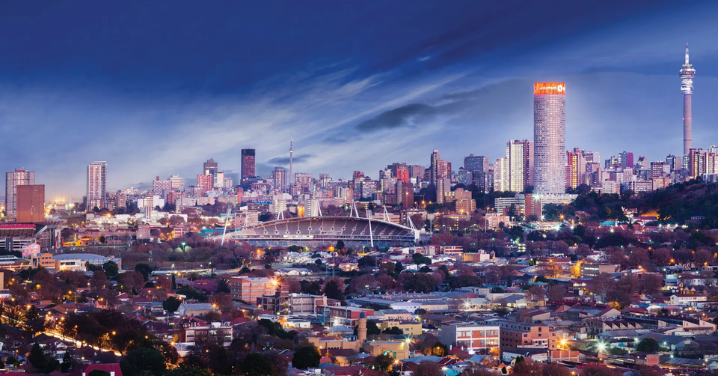
Of course, gold brought all the usual colonial drama too—land grabs, power struggles, British flags flapping in places they shouldn’t have been, Boer resistance, tension, exploitation, the lot. The city’s roots are messy. But it didn’t try to cover it up with fake gloss. Joburg grew like a teenager who got tall before they figured out how to walk properly. You can see it today—glass towers next to crumbling buildings, heritage facades squashed between office blocks, and traffic lights that sometimes forget whose turn it is. It’s a city that wears its history on its sleeve—even if the stitching’s a bit wonky.
That’s what makes Joburg fascinating. It doesn’t try to charm you with ocean views or win you over with picture-perfect streets. It shows up scruffy, late, slightly flustered, and completely itself. Where Cape Town might seduce you with a mountain and filtered sunsets, Joburg looks you dead in the eye and says, “Right, you in or out?” There’s no pretending. But if you give it a real chance, it rewards you with character, soul, and proper stories.
One of the best descriptions I’ve heard is that Johannesburg feels alive. The place hums. The graffiti in Maboneng, the street vendors in Braam, the jazz from a doorway in Newtown—it all pulses with a sort of energy you can’t fake. It’s unpredictable, sure, but never boring. One minute you’re walking past a fashion shoot happening outside a bakery, and the next you’re dodging a thunderstorm that sounds like the sky is having a breakdown. That’s just a regular Tuesday.
The people here are in a league of their own. From corporate climbers to artists, students to street sellers, no one’s idle. Everyone’s building something—sometimes three things at once. You’ll find someone who grew up in Soweto running a fintech startup in Rosebank, or a painter from the West Rand who DJs in Sandton by night. It’s not about who you know but how you move. If you’re not hustling in Joburg, you’re standing still.
And yes, it can be tough. Joburg doesn’t coddle. It keeps you on your toes. It’s the sort of place that teaches you street smarts in record time—how to read a room, check your surroundings, and make fast decisions. But it also gives you a thick skin and a sharper mind. It’s got this strange ability to wear you down and build you up at the same time. One week you’re cursing the potholes, and the next you’re defending them like they’re a weird national treasure.
There’s contrast everywhere. Bentleys next to beat-up taxis. Rooftop bars across the street from scrapyards. An artisanal bakery one block from someone braaing mielies on a drum. Somehow, it all just works. People make space for each other. Everyone’s in the same game—figuring it out, doing what they can, finding ways to thrive in a city that doesn’t make it easy but never stops moving.
The food scene deserves a moment too. It’s got layers. You could have a fancy sushi platter in Sandton, grab a kota in Alex, or get a killer vegan bunny chow from a pop-up in Melville. No one’s short on flavour. There’s a sort of honesty in the way people serve food here—no frills, just full flavour and plenty of character. And often, the best meals come from the least expected places. I’ve heard of people getting five-star curry outside a tuck shop and Ethiopian coffee that rivals anything in Milan.
Even the weather matches the city’s mood—wild and fast. Summers in Joburg are like an emotional rollercoaster. Blazing sun one minute, full-blown storm the next. Thunder that sounds like it’s trying to make a point, lightning that flashes like a paparazzi moment, then boom—sunshine again like nothing happened. It’s dramatic, unapologetic, and just a little bit theatrical. Like everything else about the place.
And then there are the hidden spots—the underground cinemas still running vintage reels, the live jazz clubs tucked behind alleyways that look dodgy until you walk in and hear magic. Places you only find if someone tells you about them. You don’t stumble across Joburg’s best bits—you earn them.
If cities had personalities, Johannesburg would be that bold, complicated friend who never says the right thing, shows up loud, sometimes makes you cringe, but always has your back. It’s flawed, raw, and rough around the edges—but also warm, sharp, and endlessly interesting. You might not fall for it at first glance, but give it time, and it gets under your skin in the best way.
So if someone ever says, “I don’t get Johannesburg,” the honest response is—they’re not supposed to. Joburg isn’t here to be simple or easy. It’s here to be experienced. Loudly, boldly, and with a little grit. The Wi-Fi might cut out mid-sentence, the traffic might test your patience, but one thing’s for sure—you’ll never forget it.