

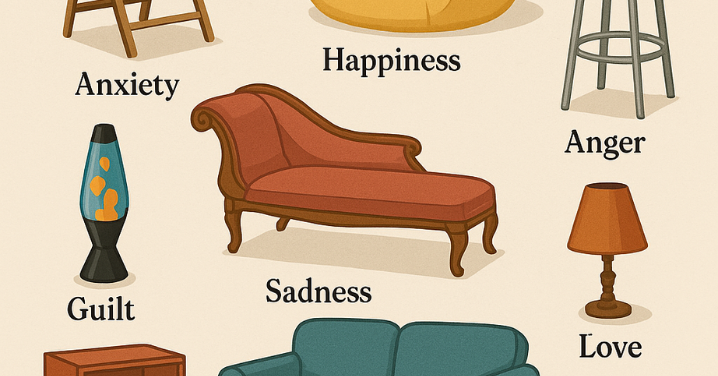
Let me just say this upfront: I never thought I’d be comparing my emotions to a side table, but here we are. Somewhere between existential dread and retail therapy, I realised that my feelings have started to resemble actual furniture—and not the stylish kind either. No, we’re talking wobbly legs, cushions that don’t match, and a suspicious stain from 2016 that no one talks about. If you’ve ever looked around your flat and thought, “This futon is giving serious post-breakup energy,” then welcome, you’re in the right place.
You know that one chair in your lounge that no one sits on because it’s weirdly angled and always covered in laundry? That’s anxiety. That’s the piece that’s technically functional, but mostly just takes up space and judges you from the corner. You try to ignore it, but every so often it topples over just to remind you it’s still there. That chair has seen things. It knows your secrets. It’s holding onto every unfinished task you thought you buried under a throw blanket.
Then there’s happiness. Happiness is absolutely a beanbag chair. Soft, ridiculous, often found in unexpected places, and weirdly hard to get into without looking like a toddler trying to win a wrestling match. When it works, it’s the best seat in the house. But when it doesn’t—say, when the beans shift or you misjudge the flop—it can leave you flat on your back wondering why you even bothered. Still, every now and then, everything aligns and you sink into that sweet spot like your soul’s being hugged by marshmallows. That’s happiness. Not perfect, not permanent, but oh so worth the tumble.
Now sadness. Sadness is a Victorian chaise lounge. Dramatic, elegant, and far too extra for your tiny bachelor flat, but there it is anyway—long, luxurious, and ready for you to collapse on it in full emotional meltdown mode. Bonus points if you drape a blanket over yourself like you’re starring in your own tragic period drama. You know the type: “The melancholy has taken me, bring me tea and soft lighting.” Sadness doesn’t care about practicality. It wants mood. It wants aesthetic. It wants a thunderstorm outside and a piano playing softly in the distance.
Anger, on the other hand, is that one metal stool you bought on sale. The one that looked cool online but in reality is loud, uncomfortable, and always in the way. It screeches when you move it. It stabs your thigh. It starts fights with your shins. You keep thinking about throwing it out, but part of you is emotionally attached now. It’s ugly, it’s aggressive, and yet somehow, it still ends up at the table more often than it should. That stool is rage. Undeniably present. Barely useful. But occasionally satisfying to kick.
Let’s not forget guilt. Guilt is a lopsided shelf. It leans just enough to make you uneasy, but not enough for you to actually fix it. You tell yourself you’ll sort it out. “Just need a screwdriver,” you mutter every time you walk past. But it’s still leaning. Still quietly judging you. Still holding onto that ceramic mug you broke three years ago and glued back together with wishful thinking and denial. Guilt doesn’t shout. It doesn’t demand. It just… sits. Unbalanced. Always there. Always waiting.
Excitement, though—that’s a lava lamp. No logic. No schedule. Just chaotic blobs of glowing optimism rising and falling at random. It doesn’t actually do anything useful, but it lights up the room and makes you feel like maybe, just maybe, you’re fun again. Lava lamp energy is what happens when your crush texts back or you find R100 in an old coat pocket. It’s fleeting, kind of weird, and only makes sense if you don’t stare too hard. But still, you love it. You love the novelty. You love the sparkle. Until the bulb dies and you have to admit you were never quite sure how it worked in the first place.
Let’s move on to love. Love is a vintage couch. Comfortable in all the right ways, but definitely with a few creaks. It’s been through some things. It’s held bodies and tears, Netflix binges and long talks at 2am. It’s got history. Maybe a stain or two. Maybe it dips a little in the middle now. But you wouldn’t trade it for anything newer. Newer is shiny. Newer is stiff. Love is that sofa that moulds to your shape, that still smells faintly like memories and maybe a bit of incense. It wraps you up without asking questions. It stays, even when the other furniture comes and goes.
Nostalgia? Nostalgia is your gran’s dining room table. The one that’s seen every birthday cake and awkward family dinner and once held a Christmas pudding that literally caught fire. It’s scratched. It’s uneven. It wobbles if you lean on it. But it holds stories like nothing else. When you sit at that table, time folds a little. You remember things you didn’t think you still knew. You laugh at the burn marks. You feel that weird ache in your chest that’s equal parts comfort and grief. That’s what nostalgia does—it feeds you, even when there’s nothing left on the plate.
Shame is that inflatable mattress you pull out for guests. Wobbly, underwhelming, and constantly threatening to deflate when you least expect it. Shame tries to look like it’s got everything together—“I’m fine! I’m totally functional!”—but let one sharp word or emotional cat walk across it, and pfffft. Gone. Back to the floor. And then there you are, lying in the ruins of your self-worth at 3am, pretending it’s fine because you didn’t need back support anyway.
Hope? Hope is a fairy light string that works most of the time. Sometimes one or two bulbs go out and you panic—but then you wiggle the wire just right and boom, everything lights up again. It’s delicate. It’s flickery. It’s not exactly reliable, but it makes the room feel magical just the same. You hang it up even when the rest of the room’s a mess, because something about it reminds you that the dark doesn’t win every time. Sometimes the small, glowy things hold more power than you expect.
Comfort is a weighted blanket. Steady. Grounding. You forget how much you need it until it’s there, draped over you like a silent “you’ve got this.” It doesn’t demand anything. It just is. Present. Heavy in a good way. The kind of thing that makes you breathe a bit deeper, like maybe the world isn’t such a mess after all. You don’t always reach for it first—but it’s the one you remember when you really need something solid.
And finally, there’s boredom. Boredom is a flatpack coffee table with a missing screw. You built it because it was there. You use it because you have to. But every time you look at it, you think, “Was this really the best I could do?” It’s functional. It’s harmless. But it squeaks. It slides when it shouldn’t. And it never quite matches the vibe. Boredom is that middle space. The IKEA purgatory of feelings.
I know it sounds mad, assigning furniture to feelings, but the more I think about it, the more accurate it feels. Because emotions aren’t abstract floaty things. They show up. They take space. They sprawl across your mental floor like a couch you can’t shift. And just like furniture, some are easy to live with. Others, not so much. Some need regular maintenance. Some arrive fully built and some… well, some are just a pile of instructions in Swedish with three screws left over and no emotional Allen key in sight.
But maybe that’s the point. Living with emotions—like living with furniture—is about figuring out what fits, what needs reupholstering, and what you’re still tripping over on your way to the kettle. Sometimes you outgrow them. Sometimes they just need a throw pillow and a second chance. And sometimes, you realise that what you thought was ugly actually works perfectly in your space.
So if you’re currently sharing your headspace with an angry metal stool, a sulking chaise lounge, and a slightly smug beanbag of joy—congrats. You’re not broken. You’re just fully furnished.