
It’s a rare privilege to revisit a piece of theatre that once made you feel like your heart had been wrung out and refilled. When The Tramp, Amanda Bothma’s lovingly crafted musical about Charlie Chaplin and his alter ego, returned to Theatre on The Square in February 2026, I rushed to book. Last year, in my previous review on The Something Guy, I called it “a pocket‑sized masterpiece” and gushed over Daniel Anderson’s ability to conjure Chaplin’s pathos and charm in equal measure. The standing ovation at the end of that evening felt less like audience etiquette and more like a collective sigh of gratitude. Coming back allowed me to watch with new eyes, noticing details I missed before and savouring the craft rather than merely the novelty.
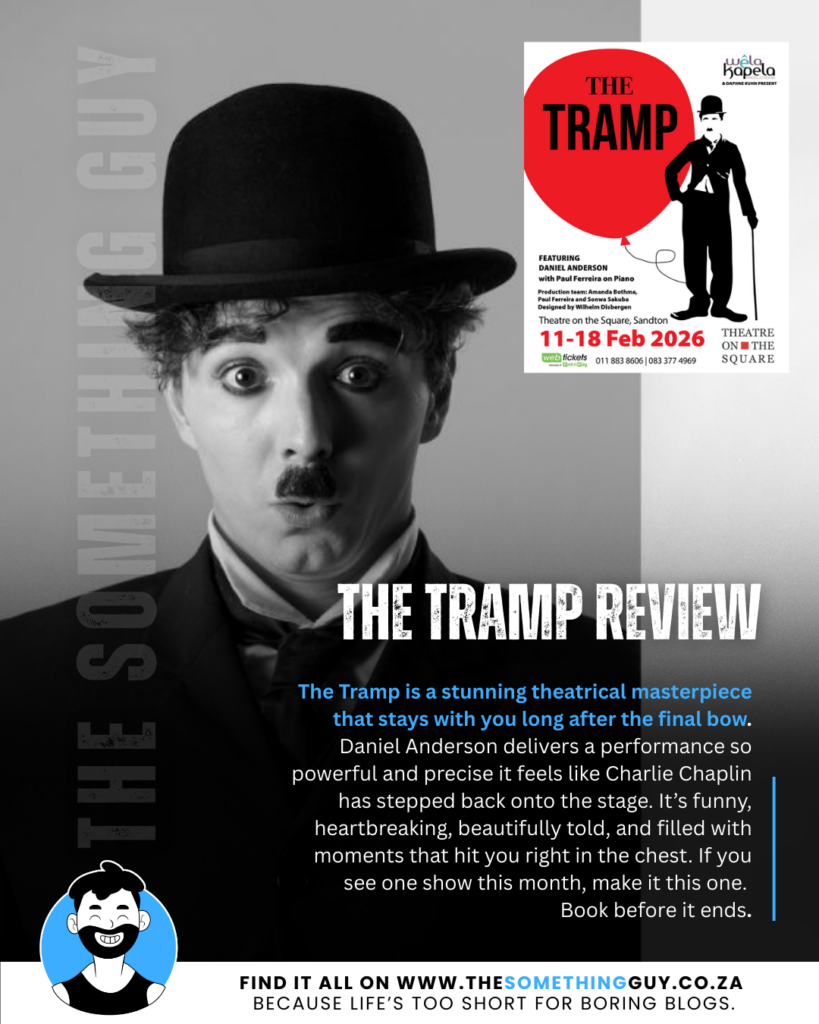
Some things remain delightfully familiar. The show still runs for about 85 minutes and is set at the cosy Theatre on The Square in Nelson Mandela Square, Sandton, where the friendly front‑of‑house staff welcome you as if you’re family. Tickets are booked through Webtickets, and the run stretches from 11 February to 28 February 2026, with evening performances at 7:30 pm and matinees on select days. If you remember the production from its July 2025 run, you’ll recall how it captured hearts; this limited engagement is both a gift and a challenge. You now have a narrow window to reconnect with The Tramp’s timeless story.
On entering the auditorium I was struck again by the uncluttered set: a few suitcases, a piano, a screen for archival footage. AV design remains tasteful and evocative. The minimalist set emphasises that Chaplin, the vagabond with the bowler hat and cane, belongs not to a specific time and place but to our collective imagination. It invites us to project our own dreams onto his wanderings.
Chaplin, Anderson and the magic of craft
What does it mean to watch the same show twice? Barry Morisse, writing about his own second encounter, suggested that a second viewing transforms the experience from a marvel at novelty into a study of craft. I found this to be true. On first viewing I marvelled at Daniel Anderson’s ability to morph his body into Chaplin’s peculiar angles. This time I paid attention to the silences between lines, the delicate interplay between Anderson and pianist Paul Ferreira, and the subtle shifts from comedy to heartbreak.
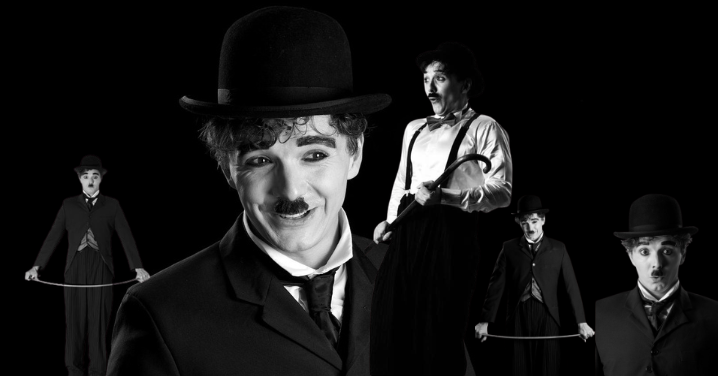
Anderson remains extraordinary. From the moment he laces up his oversized boots he radiates a mix of mischief and melancholy that is quintessentially Chaplin. In one scene he pantomimes the famous bread‑roll dance, his fingers tied with forks, each gesture a wink to film buffs. In another, he sits at the piano with Ferreira and sings in Chaplin’s own voice. Anderson’s voice is clear and his phrasing impeccable; he captures the cadence of Chaplin’s songs without ever lapsing into impersonation. His performance continues to be both technically deft and emotionally generous, a combination I rarely see.
Paul Ferreira, who accompanies Anderson on piano, is more than a musician – he is a character. He interacts with Anderson like a long‑suffering friend, sometimes admonishing him silently, sometimes joining him in song. There is a moment when Anderson, as Chaplin, looks at Ferreira with a conspiratorial twinkle, and Ferreira responds with a chord that seems to say, “I’ve got you.” That kind of interplay cannot be faked; it is the result of hours of collaboration and trust. On my second viewing I noticed how Ferreira’s playing shifts from jaunty ragtime to sombre chordal underscoring, signposting Chaplin’s emotional journey. The musical arrangements by Bryan Schimmel remain inspired, weaving Chaplin’s melodies into a cohesive narrative.
Amanda Bothma’s book and direction asked an irresistible question: who came first, Charlie or The Tramp? The show explores the interplay between the man and his creation. We see Chaplin as a young performer struggling with poverty in Victorian London, the breakthrough into film, the immigrant facing xenophobia in Hollywood, the political exile, and the older man reflecting on his legacy. The narrative flickers between these moments like old film reels, each scene prefaced by black‑and‑white footage on the screen. Bothma handles this non‑linear storytelling with clarity and care, using each episode to illuminate a different facet of Chaplin’s genius and vulnerability.
What struck me on this second viewing was the show’s philosophical depth. The script doesn’t simply chronicle biographical milestones; it meditates on the idea that the characters artists create often become inseparable from their own identities. Chaplin’s Tramp was born out of necessity – a way to survive, to make audiences laugh and forget their troubles – but he eventually consumed the man. The show asks: When does performance become reality? Bothma doesn’t answer definitively but leaves space for the audience to ponder. That open question felt even more poignant the second time, perhaps because I wasn’t distracted by plot twists.
Why seeing it twice matters
So why should you, dear reader, see The Tramp again – or for the first time? Here are a few reasons, both practical and heartfelt:
- Limited run: The production runs only from 11–28 February 2026. If you miss it now, you may never have another chance to experience this intimate telling of Chaplin’s story.
- Evolving performances: Repetition deepens artistry. Daniel Anderson, already superb in 2025, has refined his characterisation. His facial expressions are more nuanced, his physical comedy sharper, his emotional transitions smoother. Paul Ferreira’s accompaniment has grown even more responsive. The show breathes, it lives, it evolves.
- New perspectives: A second viewing allows you to notice details that passed you by. On my first visit I focused on the broad strokes; this time I noticed tiny gestures – a sigh, a raised eyebrow – that conveyed volumes. I also paid more attention to the themes of identity and belonging. If you are a returning audience member, you’ll likely find new resonances.
- Cultural importance: Chaplin remains relevant. In an age of rapid technological change, political division and mass migration, his story of an immigrant who makes people laugh while grappling with his own alienation feels urgent. Seeing The Tramp is not just entertainment; it’s a conversation with history.
- Art as community: Theatre only exists when performers and audience meet. By attending, you participate in a communal act of creation. You also support local artists – the creative team includes director Amanda Bothma, performers Daniel Anderson and Paul Ferreira, AV designers Andrew Timm and Adino Trapani, and musical arranger Bryan Schimmel – whose work deserves our patronage.
In my previous review I marvelled at the show’s emotional impact and predicted that it would linger in people’s hearts. I also mentioned that the production’s minimalism allowed it to travel easily – a suggestion that it might find life beyond Theatre on The Square. While it did tour briefly, this 2026 run feels like a homecoming. The audience’s response – hearty laughter, collective sighs, a final ovation – shows that the piece hasn’t lost its power. Seeing it again reaffirmed my belief that some stories are worth retelling.
Final reflections and a heartfelt invitation
As I left the theatre, I thought about Chaplin standing on stage in 1972, tears in his eyes, soaking in a 12‑minute ovation. I thought about the standing ovation we gave Daniel Anderson and Paul Ferreira. These moments are not about numbers; they’re about connection.
The Tramp deserves your applause. Whether you’re a lifelong Chaplin admirer or someone encountering him for the first time, this production offers a rare combination of humour, pathos, and philosophical depth. Daniel Anderson’s performance is a masterclass in physical theatre. Amanda Bothma’s direction is both compassionate and probing. The music, design and storytelling coalesce into a show that lingers long after the final bow. It is no accident that I – someone who has spent years reviewing theatre – returned for a second look and left with eyes misty and heart light. There are plenty of shows vying for your attention, but few will nourish you like this one.
So here is my appeal: don’t miss it. Book your tickets on Webtickets, head to Theatre on The Square in Nelson Mandela Square between 11 and 28 February 2026, take a seat and let yourself be transported. If you saw it last year, go again and notice what has deepened. If you’ve never seen it, prepare to fall in love with The Tramp – and maybe, by extension, with the resilient part of yourself that keeps smiling through life’s adversities.