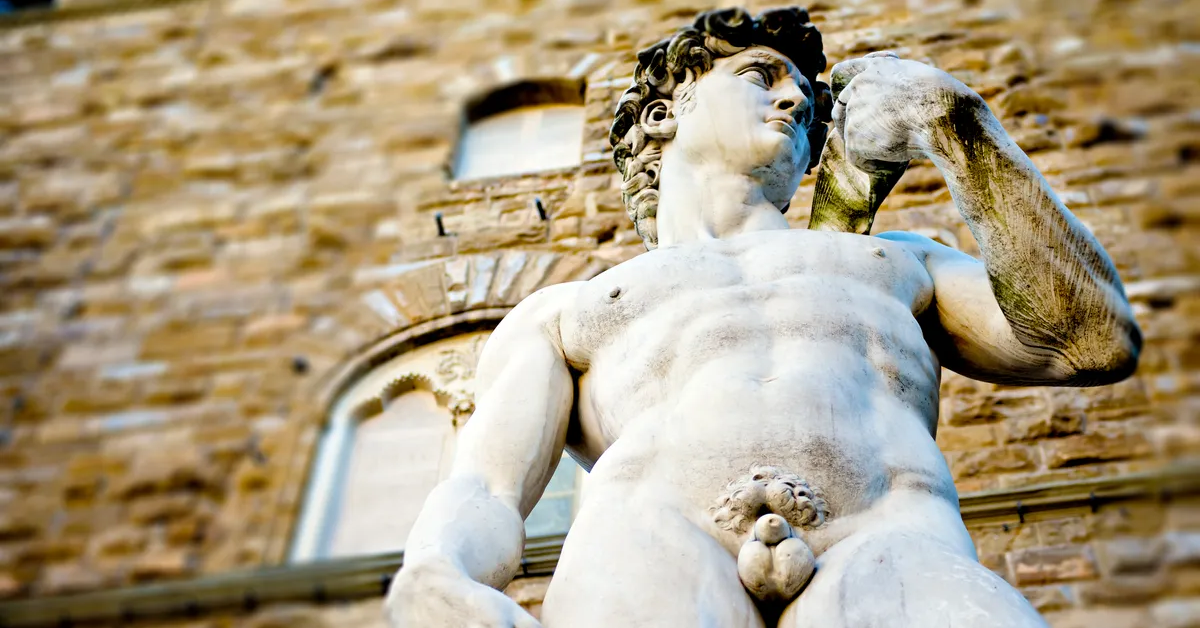
Welcome to another delightfully amusing yet educational dive into the world of art, history and, of course, some tiny tackle. You heard me right! Today, we’re discussing the peculiarly petite penises on Ancient Greek statues, a subject that has long intrigued and entertained art enthusiasts and historians alike.
Now, don’t be coy, we all know the elephant in the room, or shall I say, the not-so-mammoth member on these magnificent marble men. You’ve undoubtedly gazed upon the pristine white statues of Ancient Greece, admiring their beauty, grace and…hold on, what’s that down there? Yes, you guessed it, a rather small and unimpressive penis. But fear not! For this is not an oversight by the great artists of Ancient Greece, but rather a deliberate and fascinating artistic choice that speaks volumes about their values and ideals.

In our modern world, where size is often equated with power, virility, and success, the decision to portray these demigods of Ancient Greece with such dainty dangly bits might seem a bit peculiar. However, in order to truly understand and appreciate the intentions behind these artful appendages, we must delve deeper into the minds of the Ancient Greeks and their societal norms.
To start, let’s address the root of the matter. The Ancient Greeks were highly focused on the ideal human form, striving to create sculptures that epitomised perfection in every aspect. For them, a harmonious balance of proportion and symmetry was paramount. According to their aesthetics, oversized genitals would have disrupted the balance and visual harmony of the statue, creating an unseemly focal point that drew attention away from the overall form and beauty of the figure. In other words, a well-endowed statue would have been considered vulgar and aesthetically unpleasing to the Ancient Greeks.

Moreover, we must consider the Ancient Greeks’ values and ideals. It may come as a surprise to some that they weren’t as preoccupied with the size of a man’s manhood as contemporary societies might be. In fact, in Ancient Greece, a large penis was often associated with foolishness, lust, and animalistic traits, while a smaller penis signified intelligence, restraint, and self-control. So, in portraying their gods, heroes, and athletes with these delicate members, the Ancient Greeks were actually elevating them to a higher plane, emphasising their intellect and wisdom over baser instincts.
It is important to note that the depiction of nudity in Ancient Greek art was not meant to be erotic or crude. Instead, it was a celebration of the human form and the pursuit of physical and intellectual excellence. The statues were designed to inspire, educate, and elevate the observer, and this was achieved through their modest proportions and dignified poses. By avoiding any ostentatious displays of virility, the artists were able to focus on the true essence of the subject, revealing their inner strength and wisdom.

Furthermore, these statues were created to be admired in public spaces, such as temples, gymnasiums, and civic buildings. In such settings, the emphasis was on the collective values and ideals of the community rather than individual prowess or sexual allure. By adorning their public spaces with these modestly-endowed figures, the Ancient Greeks were reinforcing the virtues of self-discipline, wisdom, and balance that they held so dear.

Now, one might wonder if these rather unassuming appendages had any bearing on the sexual practices or expectations of the Ancient Greeks. Surprisingly, the evidence suggests that they didn’t. While a small penis may have been favoured in art, it didn’t necessarily dictate sexual preferences or standards. Ancient Greek literature and pottery depict a wide range of sexual encounters and preferences, highlighting that their society was more diverse and nuanced than we might initially assume.
So, dear reader, as we come to the end of our delightful romp through the world of Ancient Greek statues and their intentionally minuscule members, it is clear that the reasons behind this artistic choice are far from trivial. The tiny penises of these masterpieces represent the values, ideals, and aesthetics of a culture that cherished balance, wisdom, and self-control.
In the end, the itsy-bitsy secret of these Ancient Greek statues serves as a delightful reminder that beauty is indeed in the eye of the beholder and that our modern preoccupations with size and virility might just be a tad misplaced. Perhaps we could all learn a thing or two from these wise, well-proportioned, and ever-so-slightly under-endowed chaps of yore.

Enjoyed the read? Follow me!