
A Beginner’s Guide to Pagan Rituals Without the Pressure
 0
0
 0
0
 0
0
0
0
There’s something undeniably alluring about ritual—the candlelight, the incense, the slow, deliberate movement of it all. But if you’re just starting out on a pagan path, it can also feel a bit overwhelming. Do you need a wand? A cauldron? A robe? What goes where? Is there a right way? A wrong one? The good news is this: pagan ritual is less about theatrical flair and more about intention. You don’t need to spend a fortune, chant in Latin, or follow a rigid script. What you do need is presence, purpose, and a space—internal or external—where your practice can live.
Let’s start with rituals. In essence, a ritual is a focused action performed with spiritual or symbolic meaning. It could be a full moon ceremony, a seasonal celebration, or something as simple as lighting a candle to honour your ancestors. Rituals help mark time, process emotion, connect with deities or energies, and root your practice in the rhythm of the world around you. They can be long or short, complex or bare-bones. There’s no universal standard. Some people love structure. Others work entirely from intuition. Both are valid. What matters is that your ritual means something to you.
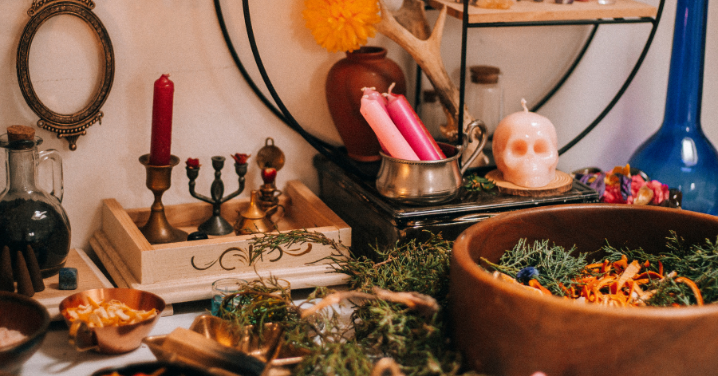
Altars are a common part of pagan practice—but again, they’re not required to be Pinterest-perfect. An altar is simply a designated space, physical or symbolic, where you focus your spiritual energy. It can be on a table, a shelf, a windowsill, a tree stump in your garden—anywhere you feel called to honour the divine, your ancestors, nature, or your own spirit. You might place candles, stones, feathers, herbs, photos, statues, or offerings. Think of it as a living space that evolves with your practice. There’s no rulebook. Some change their altar with the seasons. Others keep it steady. Some keep it visible, others private. Whatever works for you, works.
As for tools—yes, there are many in traditional pagan practice: the athame (ritual blade), chalice (cup), wand, pentacle, cauldron, incense, bells, besoms (brooms), and more. Each has symbolic meaning, often linked to the elements or specific types of work (protection, blessing, cleansing, etc.). But here’s the thing: you don’t need any of them to begin. You can build your toolkit over time, if it feels right. You can make your own. You can use what you already have. Your great-grandmother’s teacup can be your chalice. A stick you found on a walk can be your wand. What matters is the intention behind it, not the label on the box.
And if tools do call to you—take your time. Let them find you. Visit local metaphysical shops, browse online, or wait for a birthday gift that just clicks. Cleansing tools (like sage, incense, or salt), items representing the elements (a candle for fire, a bowl of water, a plant or stone for earth, a feather or chime for air), and a journal are all great starting points.
When setting up your first ritual or altar, start simple. Light a candle. Say a few words of gratitude or intention. Breathe. That’s it. There’s no need to recite ancient invocations or follow someone else’s script unless it resonates with you. Over time, you’ll build your own rhythms, phrases, and gestures—your own sacred language.
Some practitioners like to cast a circle—symbolically marking out a sacred space for their ritual. Others skip it entirely. Some call the quarters or elements. Some invoke deities. Some prefer silent meditation. Paganism isn’t about one correct way—it’s about finding your way. Ritual should feel grounding, not stressful. Empowering, not performative.
And a quick note: pagan practice doesn’t have to be public. It’s okay to keep things quiet, personal, or even secret. Especially in spaces where you may not feel safe being open. Your connection is still real. The gods (or energies, or ancestors) don’t require candles from a specific shop or words in a certain order. They care that you showed up.
If you’re someone who thrives on order, go ahead and map out your rituals in a notebook. Build a routine. If you’re more spontaneous, let your intuition lead. You can journal, draw tarot, burn herbs, sing, dance, sit in silence. There is no hierarchy of practice. The smallest, simplest act done with clear intention is more powerful than the fanciest setup done without heart.
And finally—don’t be afraid to change things. What works for you this month might feel different next season. That’s the beauty of a living path. You’re allowed to evolve, experiment, get it “wrong,” and start again. Paganism welcomes that. It’s not about perfection. It’s about presence.
So whether your altar is a shoebox on your bookshelf or a sprawling collection of crystals and candles; whether your rituals are elaborate moonlit ceremonies or quiet moments with a cuppa and a deep breath—you are doing it right. Because you’re doing it with intention. And that’s where the magic lives.