The History of Labyrinths: From Ancient Paths to Modern Mindfulness
 0
0
 0
0
 0
0
0
0
There’s something quietly mesmerising about a labyrinth. Not the chaotic hedge mazes of childhood stories, but the ancient, singular-path designs etched into stone, sand, and memory across centuries and continents. Unlike a maze, which is designed to confuse and challenge, a labyrinth has no dead ends. Just one winding path that eventually leads you to the centre—and back out again. It’s not a puzzle to solve. It’s a journey to experience. And for thousands of years, civilisations around the world have walked that path for reasons that go far beyond navigation.
Labyrinths go way back. Like, Bronze Age back. The earliest known example is the famous seven-circuit design found on a clay tablet from Pylos, Greece, dating to around 1200 BCE. But similar patterns have popped up in vastly different cultures: Native American petroglyphs, Scandinavian rock carvings, Indian temple floors, Celtic turf mazes, and even Hopi pottery. Either the world’s ancient architects were having a very long game of telepathic design tag, or the labyrinth speaks to something deeply universal.
In Greek mythology, of course, the labyrinth is most famously associated with King Minos and the Minotaur. The idea of a confounding structure built to contain something monstrous taps into the symbolic power of the labyrinth as a representation of fear, entrapment, and hidden truth. But here’s the twist: the actual archaeological evidence suggests the original labyrinth may not have been nearly as confusing. Instead, it was likely a single, spiralling path—less about trapping beasts and more about self-reflection and ritual.
Throughout history, labyrinths have served as spiritual tools. Medieval Christians, for example, built them into the stone floors of cathedrals like Chartres in France. Unable to make a pilgrimage to Jerusalem? Walk the labyrinth instead—it’s the symbolic equivalent. A meditative, meandering prayer. In Nordic regions, fishermen walked labyrinths before heading to sea, hoping the journey would trap malevolent spirits and keep them safe. And in India, the labyrinth’s form is linked to mandalas and yantras—symbolic diagrams that aid in meditation and spiritual awakening.
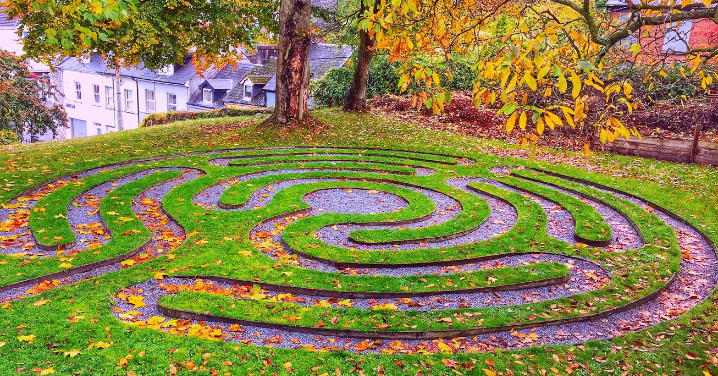
Labyrinths pop up in folklore and landscape art, in sacred geometry and urban parks. They’ve been drawn, carved, grown, and danced. And their purpose has morphed over time: from ceremonial to therapeutic, from mythical to modern mindfulness. The thread tying it all together is this: you walk it slowly, deliberately, sometimes alone, sometimes with others—but always with the understanding that it’s not about getting somewhere. It’s about being somewhere.
In South Africa, while labyrinths aren’t traditionally embedded in indigenous culture, they’ve become increasingly popular in wellness spaces, retreat centres, botanical gardens, and even private homes. Walking a labyrinth here often borrows from the global tradition: used for reflection, grounding, or simply finding calm in a chaotic world. You can find one tucked away in Kirstenbosch, spiralling quietly amid the flora, or in the Drakensberg, where mountain air makes each step feel crisp and purposeful.
The symbolism of the labyrinth is layered. It can represent life’s journey, the winding road of the soul, the spiral inward toward self-awareness, or even the cosmic dance of order and chaos. You enter it with whatever you carry—questions, anxiety, hopes—and the act of walking, with its twists and turns, mirrors the internal unraveling and re-weaving of thought. It’s movement with meaning, pattern with purpose.
And it’s no surprise that in today’s ever-rushing world, labyrinths are making a quiet comeback. They offer something digital life can’t: slowness. Presence. A structured meander in a world obsessed with destinations. You don’t need to be spiritual, poetic, or especially bendy to appreciate one. You just need to walk.
So if you ever stumble across a spiral etched into stone or find yourself invited to trace a path with your feet and breath, go ahead. It might look simple. It might feel strange. But somewhere between the entrance and the centre, you may just find what you didn’t know you were looking for.