

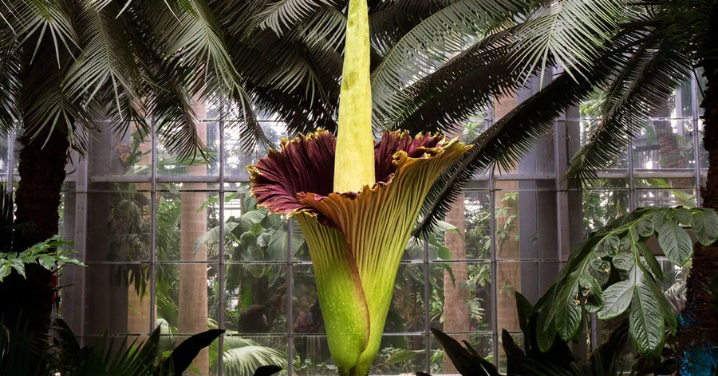
There are flowers that whisper gently in a breeze, flowers that politely wait to be admired, and then there is the Titan Arum, the world’s biggest floral diva, a plant so unapologetically dramatic that it has been nicknamed “The Corpse Flower.” Even before you see it, you know it’s in the room. Why? Because it smells like a dead animal baking in the sun. Most flowers invite you in with perfume; this one assaults your senses with eau de rot. And yet, despite its unpleasant reputation, people queue for hours to catch a glimpse of it. There is something magnetic about the grotesque, especially when it arrives packaged in nature’s grandest form.
The Titan Arum, or Amorphophallus titanum if you feel like showing off at a dinner party, is not your average garden flower. For one thing, you couldn’t exactly plop it into your front yard unless you wanted your neighbours to file noise complaints about the smell. Native to the rainforests of Sumatra, it is a plant that demands attention by being both ridiculously large and absurdly rare. We are talking about a bloom that can reach more than three metres in height, unfolding into a massive, sculptural display of crimson and green that seems to say, “Yes, I am the star, and you are all just extras in my show.” It is a marvel of the plant kingdom, not only for its size but also for the bizarre combination of allure and repulsion it embodies.

What fascinates me about the Titan Arum is not just its biological eccentricity but the way humans respond to it. When one blooms in a botanical garden, crowds gather as though Beyoncé herself were about to perform. News outlets cover it. Scientists hover like paparazzi with measuring tapes and notepads. Visitors arrive with children perched on shoulders, eager to catch sight of the beast in bloom. All for a flower that spends most of its life looking rather unimpressive, quietly storing energy underground in a corm the size of a boulder, only to burst forth once every several years in a bloom that lasts just a couple of days. It is a reminder that patience sometimes rewards us with spectacle.
Here’s the funny thing though: people flock to it despite its reputation for smelling absolutely foul. If anything, the smell adds to the attraction. We are a species that thrives on novelty, and what could be more novel than willingly sniffing a flower that mimics carrion? There’s almost a carnival energy around it. The irony is delicious—people wrinkle their noses, laugh nervously, and then pose for photos next to this floral oddity, immortalising their disgust. It makes me think about our strange relationship with beauty and repulsion, and how often the two are entangled. Perhaps we love the Titan Arum precisely because it refuses to conform to what we expect from a flower.
Scientifically speaking, the smell serves a clever purpose. Unlike roses that court bees or lilies that woo moths, the Titan Arum attracts pollinators with darker appetites: carrion beetles and flesh flies. These creatures are drawn to the promise of decay, and the flower obliges with a scent profile that could rival a landfill on a hot day. It is an ingenious bit of evolution, really, even if it makes our stomachs churn. The plant uses deception to reproduce, tricking insects into playing matchmaker under false pretences. And in that deception, there is a sort of brutal honesty about the natural world: beauty is not always sweet, and survival often requires theatrics.
Thinking about it, the Titan Arum feels like a metaphor for the parts of life we tend to avoid but cannot ignore. It is the reminder that not everything worth paying attention to will be pretty or pleasant. Sometimes, the most significant things arrive wrapped in discomfort. Much like grief, illness, or even uncomfortable truths, they force us to confront reality head-on. You can’t stand next to a Titan Arum without acknowledging its presence—it demands that you experience it fully, smell and all. And isn’t that a little like life itself? The moments that leave the strongest impressions are often not the easiest or sweetest, but the ones that shake us awake.

What also amazes me is the sheer patience required of the plant. Imagine spending years hoarding energy underground just to bloom for a fleeting moment, then collapsing again into quiet obscurity. It is the ultimate slow burn, the plant equivalent of a one-hit wonder that takes a decade to release a song. And yet, when it does bloom, it becomes unforgettable. There’s something almost poetic about that cycle. In a world obsessed with instant gratification, the Titan Arum offers a lesson in patience, preparation, and the beauty of rarity. It reminds us that not everything should be constant; sometimes, infrequency makes an experience sacred.
Of course, there is also the undeniable absurdity of it. Here we are, intelligent beings capable of landing probes on comets, yet we queue around the block for a flower that smells like roadkill. There is something humbling in that. The Titan Arum strips away pretence and reveals our fascination with the extremes of nature. It shows us that, no matter how sophisticated we pretend to be, we are still creatures who delight in being shocked and awed by the strange. And maybe that is a good thing. Wonder is not always neat and perfumed. Sometimes, it is messy, overwhelming, and slightly offensive to the nostrils.
When I think of the Titan Arum, I also think of the fragility of the ecosystems that nurture such oddities. This plant is native to the rainforests of Sumatra, a place under constant threat from deforestation. The fact that so many of us know the Titan Arum not from the wild but from carefully cultivated specimens in botanical gardens speaks volumes. It is both a success story of conservation and a cautionary tale. We marvel at it in glasshouses and city centres, but in its true home, its survival is tied to fragile habitats that humans are steadily eroding. To admire it without acknowledging that would feel dishonest.

So yes, it is a flower that reeks. It is a flower that plays hard to get, appearing only once in a blue moon. It is a flower that tricks insects into doing its dirty work. And yet, it is also a flower that reveals something profound about us: our hunger for awe, our willingness to embrace discomfort, and our role in preserving the strange miracles of the world. The Titan Arum is not conventionally beautiful, but perhaps that is precisely why it matters. It challenges us to rethink what we value in nature, and in ourselves.
Standing before one, you are confronted with the reality that life is not all roses and lilies. Sometimes it is towering, smelly, and inconvenient. But it is also extraordinary. The Titan Arum is a lesson in extremes, in patience, in the strange dance between attraction and repulsion. And maybe the best part is that it refuses to be ignored. In a time when so much of life blends into a grey blur of routine, this monstrous bloom arrives like a thunderclap, reminding us to stop, pay attention, and let ourselves be stunned.
Perhaps the truth is this: the Titan Arum is not just a plant. It is a performance, a spectacle, a fleeting miracle that asks us to consider the value of rarity in a world obsessed with abundance. And in the end, when the bloom collapses and the smell fades, we are left with the memory of having witnessed something unapologetically alive. That memory, like the plant itself, lingers far longer than the stench.