

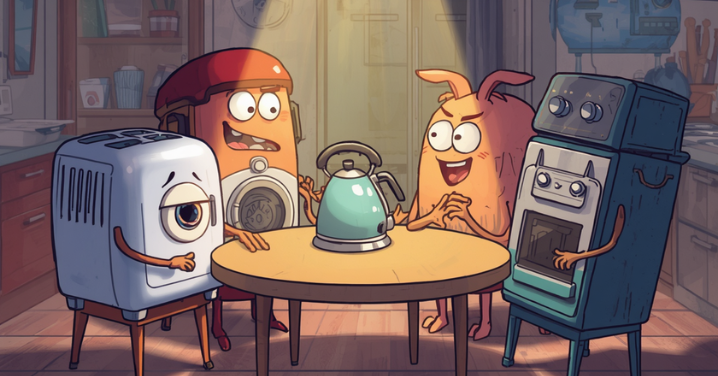
There comes a day in every person’s life when they look around their kitchen and realise they are not the one in charge. You think you own these appliances. You paid for them. You plugged them in with your own two hands. And yet here you are, negotiating with a toaster like it holds leverage over you, because in a very real sense, it does.
Let us start with the toaster, since it started this whole investigation. The toaster is the appliance equivalent of a colleague who is lovely nine times out of ten and then, on the tenth time, quietly sets your breakfast on fire while maintaining full eye contact. You never know which morning you are getting. Golden perfection or a smoke alarm symphony. There is no dial setting trustworthy enough to fix this. The toaster does not answer to numbers. It answers to vibes, and its vibes are chaotic.
The washing machine, meanwhile, has perfected the art of emotional unavailability. It will take your clothes in, spin them around in what can only be described as a small, tumultuous relationship, and then, without warning, decide the load is unbalanced. Not too much washing. Not too little. Unbalanced, as though your socks have personally wronged it. You rearrange nothing. You simply stand there, rejected, while a machine the size of a fridge judges your laundry choices in silence.
Then there is the kettle, which is honestly fine. The kettle is the reliable friend. It boils, it clicks off, it asks for nothing in return except the occasional descaling, which frankly is less maintenance than most humans require. The kettle has never once betrayed anyone. Let the kettle live.
The microwave sits in a strange middle ground. Mostly loyal, occasionally menacing. It will heat your leftovers perfectly for months and then, completely unprompted, decide today is the day to make a noise like a small aircraft attempting takeoff. You do not investigate. You simply accept that the microwave has opinions now.
And finally, the air fryer. We need to talk about the air fryer, because the air fryer has quietly become the most powerful appliance in the house and it knows it. It arrived humble, promising crispy chips with less oil, and now it has a cult following, its own recipe books, and an unspoken authority over the entire kitchen counter. The toaster has been demoted. The oven barely gets used anymore. The air fryer did not ask for this power. It simply took it, the way certain appliances do when nobody is paying attention.
So here we are, living among machines that hum politely by day and plot by night. We do not own our appliances. We coexist with them, cautiously, gratefully, and slightly afraid of what the toaster is planning next.