
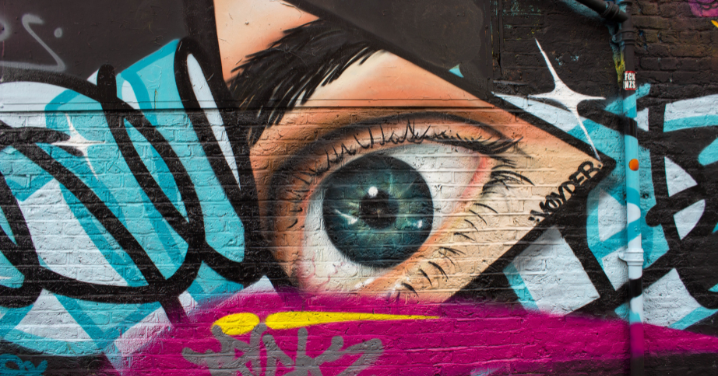
Once dismissed as vandalism and rebellion in spray paint, street art and graffiti have evolved into powerful forms of visual communication, social commentary, and even high art. From the hurried tags on alley walls to the intricate murals that span city blocks, graffiti has transformed over decades—morphing from underground subculture into celebrated creative expression. But its roots? Raw, political, and fiercely personal.
The story begins on trains and tenement walls in 1970s New York. Young artists, often from marginalised communities, began tagging their names—simple pseudonyms scrawled across urban surfaces. It wasn’t about property damage; it was about visibility. In a society where many felt invisible, graffiti was a way to say, “I exist.” It quickly escalated into complex lettering styles, full-car masterpieces, and a cat-and-mouse game with city authorities. What started as defiance soon gained recognition as a form of identity and artistry.
By the 1980s, graffiti’s bold colours and aggressive fonts began influencing everything from music to fashion. Hip-hop culture embraced it as a visual extension of beats and bars. Simultaneously, artists like Jean-Michel Basquiat and Keith Haring bridged the gap between the street and the gallery, challenging notions of where art belongs and who gets to make it.
Meanwhile, across the Atlantic, European cities began developing their own graffiti subcultures. In Berlin, London, and Paris, artists adopted American techniques but added local flavour—often incorporating political messages and satire. The Berlin Wall, in particular, became a living canvas, with layered artworks chronicling the divide and eventual unification of a city. Street art had grown teeth—it wasn’t just decorative. It was disruptive.
Then came the rise of stencil art, paste-ups, and installations. These techniques allowed for faster, more reproducible forms of street expression. Enter Banksy, the elusive British artist whose biting social commentary turned walls into billboards for resistance. Suddenly, street art was on auction blocks, and pieces of walls were being sold for millions. The art world took notice—but the street never fully surrendered its edge.
In South Africa, graffiti and street art took on their own powerful resonance. During apartheid, protest slogans and resistance art became tools of communication when voices were silenced. Post-apartheid, walls became places of memory, healing, and critique. From Cape Town’s District Six murals to Joburg’s Maboneng street galleries, the country’s walls now tell stories of pain, pride, transformation, and hope.
Today, street art is both mainstream and underground. You’ll find massive public commissions side-by-side with guerrilla art that vanishes overnight. Cities host mural festivals. Social media boosts artists into global fame. Yet, the tension between art and illegality remains. What’s the difference between a mural and vandalism? Sometimes, just permission.
At its best, street art challenges complacency. It disrupts sterile spaces. It asks questions. Who owns public space? Whose voices are allowed to be loud? Whether it’s a political protest or a purely aesthetic splash of colour, graffiti invites you to look again—and maybe, to feel something different the second time.
So next time you walk past a painted wall, take a moment. What started as a quiet rebellion might just be speaking directly to you.