

History loves to make the Middle Ages look glamorous. It gives us knights in shiny armour, castles on the hill, kings delivering stirring speeches and peasants quietly tilling the fields in the background. What it does not usually include is the fact that sometimes an entire room of nobles fell through the floor and drowned in human waste. That is not exaggeration. That is not satire. That is the very real Erfurt Latrine Disaster of 1184, one of the most humiliating tragedies in human history.
It all began with a nineteen year old king who wanted to prove himself. Henry VI, son of Emperor Frederick Barbarossa, was left in charge while his father was off crusading. To show his strength he called a peace conference in the city of Erfurt. Two powerful lords were locked in a feud and Henry thought it would make him look authoritative if he gathered everyone together and forced them to sort it out. Roughly one hundred nobles showed up. These were not your everyday peasants. These were counts, dukes and archbishops, men who strutted about in heavy armour, who spent their days squeezing taxes from villagers and who truly believed they were the most important beings alive. They filled the bishop’s assembly hall, polished, armed and full of self importance.
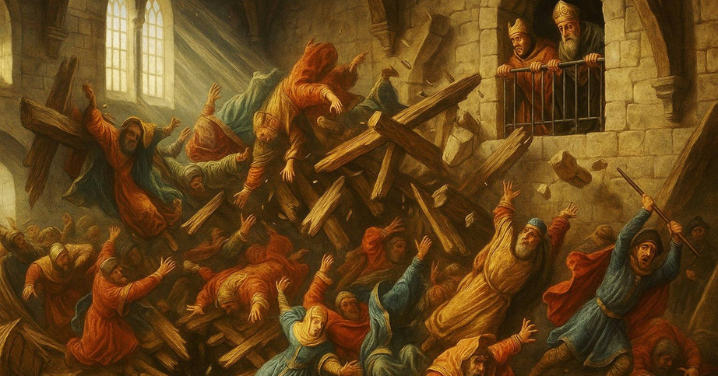
What nobody realised was that the hall was a death trap. It had been built directly above a massive cesspit. Waste from the building was dumped into the pit and centuries of filth had collected there. The nobles crammed onto the wooden floorboards, stomping, gesturing, waving arms, heavy boots and chainmail pressing down on beams that were never designed to hold that much weight. The timber creaked, the beams bent, and then the entire thing gave way.
Picture the chaos. One moment you are loudly demanding land rights, the next you are plummeting through the floorboards with dozens of other men, crashing into darkness. And then you hit it. Not soil. Not a cellar full of wine. A pit of human excrement. The smell alone must have been overwhelming. The reality worse. Heavy armour does not float. Helmets fill with filth. Swords and shields drag you down. Men flailed, clawed and screamed, but it was useless. Around sixty nobles died, either drowning, suffocating or crushed under the weight of others. Imagine being a duke who spent his life lording over peasants only to end up gasping for air in a pit of waste. Imagine the last sight of your noble comrade as he thrashes beside you in the same muck. There is no poetry in that, only horror and humiliation.
Henry himself survived by sheer luck. He had been standing near a window and when the floor collapsed he managed to hold on. From his position he watched the disaster unfold. Think of the scene. A teenage king trying to prove himself suddenly finds the council he organised reduced to screams from a cesspit. His great moment of political theatre literally flushed away before his eyes. For the survivors who scrambled out of the muck, their dignity was gone forever. You could not walk through the empire with pride after everyone had seen you stumble out dripping and stinking. Some wounds cannot be scrubbed off.
The symbolism was too perfect to ignore. Medieval people loved to see divine signs in everything. A comet was a warning. A flood was a punishment. And here was the most on the nose message of them all. The mighty had been literally dumped into the filth of their own making. They built their lives on exploiting the people beneath them, on consuming and taxing and ruling, and then the earth opened up and gave them exactly what they deserved. To contemporaries it must have looked like the hand of God pushing them down into the muck. To us it looks like the universe writing satire so sharp no modern comedian could improve on it.
What makes this story even more fascinating is how little it mattered in the grand scheme. Unlike wars that changed borders or assassinations that reshaped kingdoms, this disaster left politics untouched. Henry carried on and eventually became emperor. The feud between the lords did not vanish. The empire trudged forward as though sixty of its nobles had not just died in the most humiliating way possible. For most of them their names are lost. Their deeds forgotten. What remains is this one grotesque footnote. Their legacy is that they drowned in a toilet. If you were their descendant, how would you ever bring that up with pride?
And yet here we are, centuries later, still telling the story. It survives precisely because it is absurd. It shocks, disgusts and entertains all at once. It tears away the romantic gloss of the Middle Ages and replaces it with something far more human. Nobles did not just charge into glory with banners flying. Sometimes they slipped, fell, and drowned in the very waste they tried to avoid. It is Monty Python with a tragic ending. It is the sort of story that sticks in your mind because you cannot quite believe it, but you also cannot deny it.
If it happened today it would dominate the internet. Headlines would scream about world leaders lost in septic tanks. Memes would flood timelines. Conspiracy theorists would insist it was sabotage. Comedians would never stop making jokes about it. Somewhere a crisis management team would be sweating, trying to find a way to phrase sixty deaths in a sewage pit as something other than an international embarrassment. In 1184 it was simply recorded in a chronicle and filed away. That is what makes the Middle Ages both fascinating and terrifying. Events that would shock the world today were just another line of text then.
The Erfurt Latrine Disaster sits comfortably in the gallery of history’s most humiliating ends. It belongs alongside the Dancing Plague of 1518, where people literally danced themselves to death, or the Cadaver Synod of 897, when a pope’s corpse was dragged out of its grave and put on trial. It belongs next to the Great Emu War of 1932, where Australians with machine guns lost to giant birds, and the exploding whale of Oregon in 1970, when dynamite turned a beached carcass into raining blubber. These stories endure not because they changed the world but because they reveal something truer. History is not just noble speeches and solemn portraits. It is also chaos, stupidity, and moments so absurd they leave you speechless.
So what does this disaster teach us? Maybe it shows that no amount of power makes you immune to humiliation. Maybe it shows that humans have always been bad at planning. Maybe it simply shows that the universe has a cruel sense of humour. Those nobles thought they were untouchable. They walked into that hall proud and self assured. They left as the butt of a joke that has lasted more than eight hundred years. And honestly, it feels like justice.
The Erfurt Latrine Disaster is a reminder that history is not just written in golden ink. Sometimes it is written in filth. Sometimes it is the story of sixty nobles drowning in a cesspit. And that, strangely enough, makes it one of the most honest and human stories of the Middle Ages.
About the Author