

There is something quietly devastating about growing up.
One day, you are a child who can turn a teacup into a castle, a shadow into a monster, a curtain into a forest, and a cardboard box into a kingdom. Then, without warning, you are an adult with unread emails, weird back pain, and a phone that somehow knows you looked at one pair of shoes six weeks ago.
Somewhere between imagination and responsibility, we lose a little of that childhood magic. Not all of it, hopefully. Just enough to make us forget how powerful play can be.
That is where Jessica Haines’ acclaimed one-woman show, Once Upon a Teacup, seems to live. Right in that delicate space between memory and modern life, between childhood wonder and the very adult pressure to keep up, fit in, and make sense of the world without completely falling apart.
After captivating audiences at its world premiere in Sri Lanka and earning glowing praise at the Hilton Arts Festival in KwaZulu-Natal, Once Upon a Teacup now makes its long-awaited Johannesburg debut at Theatre on the Square in Sandton from 28 July to 1 August 2026.
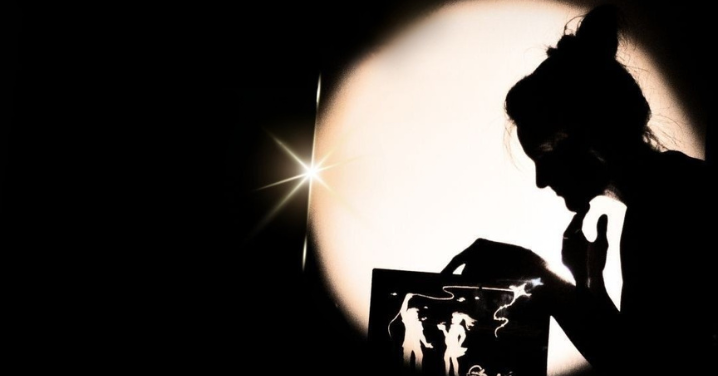
Written and performed by Jessica Haines, and directed by multi-award-winning theatre-maker James Cuningham, the production is a 70-minute work of physical, visual, and shadow theatre. It follows Violet, a young girl growing up in Africa, as she moves through the rich landscape of childhood imagination and into the more complicated pressures of the modern world.
What makes the work especially intriguing is how it is told. The script is written entirely in rhyming couplets, while the staging combines light, shadow, movement, object puppetry, and a sparse collection of props to create something tender, funny, unsettling, and deeply human.
In other words, it is not the kind of show that needs a massive set, fifty costume changes, or a chandelier falling from the ceiling to make an impact. Sometimes all you need is a performer, a story, a shadow, and the emotional ambush of remembering who you used to be.
“Once Upon a Teacup begins on a farm in KZN and I hope audiences will recognise the many character archetypes that I bring to life,” says Haines.
“The play explores the notion and power of imagination and the toll it takes under pop culture constructs, social media, and the inevitable pressure of growing up. Violet’s mental health is compromised and she soon finds herself in a dark and unpredictable place, only to be rescued by the concept of home and the memories of her childhood.”
At the centre of the production is Violet, but around her is an entire world shaped through Haines’ physicality and imagination. The story begins in the familiar textures of childhood, where the ordinary becomes extraordinary, and then gradually shifts into something darker and more uncertain.
That movement from play to pressure feels painfully recognisable. Childhood gives us permission to invent wildly. Adulthood often asks us to edit ourselves down until we become acceptable, productive, presentable versions of who we once were. Lovely stuff, really. Ten out of ten, no notes, except perhaps several notes and a small existential groan.
But Once Upon a Teacup is not simply about growing up. It is about what gets lost along the way. It looks at imagination not as something childish, but as something essential. A survival tool. A form of memory. A way back home.
“I’m hoping the story reawakens the child in everyone,” says Haines, “the lost ability to play, create, and fully invest in the colourful and crazy world of our imagination, which is so often diluted by the fast pulse of adulthood.”
That idea feels especially powerful now, in a world where attention is constantly being pulled in a hundred directions. Social media has changed the way people perform themselves. Pop culture shapes expectations. The pressure to grow up, succeed, look fine, be fine, and post something that suggests everything is fine can become its own strange theatre.
Once Upon a Teacup appears to push back against that. Not loudly, but poetically. Through Violet’s story, it asks what happens when the inner world starts to fracture, and what might still rescue us when it does.
The production has already made an impression on critics. At the Hilton Arts Festival, reviewer Coralie Diack, writing for The Critter, described the work as “a magical serving of artistry,” praising Haines’ characterisation, expressive physicality, and authentic intimacy. The review concluded that the show “leaves one weeping.”
At its 2024 world premiere in Colombo, Sri Lanka, Daily FT theatre critic Savithri Rodrigo wrote that audiences “sat in awe” as Haines moved through Violet’s layered life, praising the performer’s energy and describing her use of light, shadow, and props as “ingenious.”
That kind of response makes sense when you consider the roots of the production. Once Upon a Teacup grew out of Haines’ studies in shadow theatre under Norbert Gotz and the Theatre der Schatten in Bamberg, Germany, in 2024. Shadow theatre is an art form that relies on suggestion as much as spectacle. It allows the unseen to become visible, and the ordinary to become strangely alive.
For a story about imagination, memory, and mental health, that feels like a perfect theatrical language. Shadows, after all, are never just shadows on stage. They can become fear, comfort, memory, threat, playfulness, or home. They can stretch something tiny into something enormous. Much like childhood itself.
Haines brings a rich artistic background to the work. A UCT-trained actress, director, and artist, she has worked across film, television, and theatre for more than two decades. She is perhaps best known for her leading role opposite John Malkovich in Disgrace, based on the novel by JM Coetzee, as well as television work on Home Affairs, Isidingo, Gazlam, and Reyka.
She is also a visual artist, with work exhibited at the Lionel Wendt Gallery in Colombo, Sri Lanka. That visual sensibility seems to sit at the heart of Once Upon a Teacup, where the storytelling is not only spoken, but shaped through image, movement, object, and shadow.
Director James Cuningham brings his own considerable experience to the production. A Le Coq-trained actor and director, he has worked across more than 60 theatre, film, and television productions in 15 countries, with credits alongside Idris Elba, Jonathan Bailey, and Ian McKellen.
Together, Haines and Cuningham have created a work that seems built for audiences who love theatre that trusts them. Theatre that does not over-explain. Theatre that leaves space for feeling. Theatre that reminds us that a small stage can hold an entire childhood if the storytelling is strong enough.
And Theatre on the Square feels like the right Johannesburg home for this kind of piece. It is an intimate venue, the kind of space where a performer cannot hide behind scale. Every breath, shift, glance, and silence matters. For a one-woman show built on intimacy and transformation, that proximity can be magic.
Once Upon a Teacup is one of those productions that sounds gentle at first glance, but there is clearly something sharper beneath the surface. A girl growing up in Africa. A world built from imagination. The pressure of modern life. Mental health. Memory. Home. The strange grief of becoming older and realising that the child you once were is still somewhere inside you, probably asking why you stopped making things up for fun.
That may be the real pull of the show. It does not seem to ask audiences to return to childhood in a sentimental way. Rather, it asks whether the imagination we leave behind might still have something to teach us.
Perhaps play is not the opposite of seriousness. Perhaps it is one of the ways we survive seriousness.
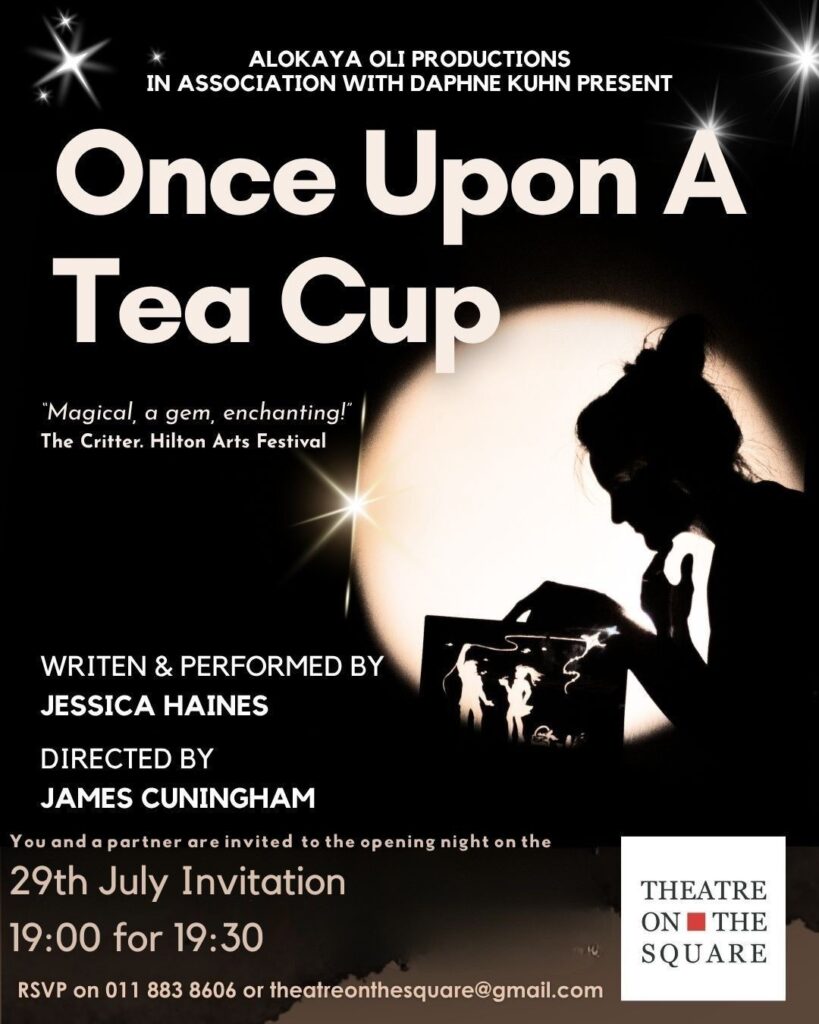
Once Upon a Teacup runs at Theatre on the Square, Sandton, from 28 July to 1 August 2026.
Tickets are available through Webtickets.
Event Details
Production: Once Upon a Teacup
Written and performed by: Jessica Haines
Directed by: James Cuningham
Venue: Theatre on the Square, Sandton
Dates: 28 July to 1 August 2026
Running time: 70 minutes
Tickets: Available via Webtickets
More information: www.theatreonthesquare.co.za