
Somewhere in South Africa right now, a child is standing at the edge of a swimming pool, dripping wet, and being told they have to wait thirty minutes because they just had viennas and chips for lunch.
That child is all of us. That child has been all of us since roughly 1987.
We grew up on a steady diet of rules. Some came from our parents, some from Ouma, some from a teacher in a chalk-dusted cardigan standing next to a laminated poster, and a surprising number from that one cousin who always “read it somewhere.”
Nobody questioned any of it. Why would you? These were the people who knew how the geyser worked. They knew which Tupperware lid belonged to which container. They had authority.
Then the internet grew up, science had a few more decades to do its homework, and one by one the rules started falling over like a badly stacked Jenga tower at Christmas lunch.
So this is a gentle, loving, slightly cheeky audit of everything we were told growing up that turned out to be, well, not quite true.
Nobody is in trouble. Your mum did her best. She was working with the information she had, a Telkom landline, and a set of encyclopaedias someone sold her at the front door.
Let’s start with the pool.
The thirty minute rule after eating was enforced in South African households with the same seriousness as the “don’t sit on the good lounge suite” policy. You’d sit on the edge of the pool with your feet in the water, watching the kitchen clock like a prisoner counting down to parole.
The theory was that digestion pulls all your blood to your stomach, your arms and legs cramp, and you sink to the bottom like a dropped Lego brick.
There’s no evidence that this actually happens. At most, you might feel a bit sluggish after three boerewors rolls. That isn’t a medical emergency. That’s a Sunday.
Every one of those half hours spent sulking on the pool steps is gone forever. I think about that more than I should.
Next up, the great sugar panic.
If you went to a children’s party in the nineties, you’ll know the moment. A child is running in circles, shrieking, wearing a party hat as a chin strap, and an adult nods wisely and says, “It’s all the sugar.”
Here’s the twist. A 1995 analysis of controlled studies found that sugar doesn’t affect children’s behaviour. Even better, other research found that when parents were told their child had eaten sugar, even when the child hadn’t, they rated the child as more hyperactive.
So the sugar rush is real. It just lives in the parents.
The children were simply at a party. With balloons. And a jumping castle. And fourteen other children. Of course they were losing their minds. You would too.
Then there were the eyes. Oh, the eyes.
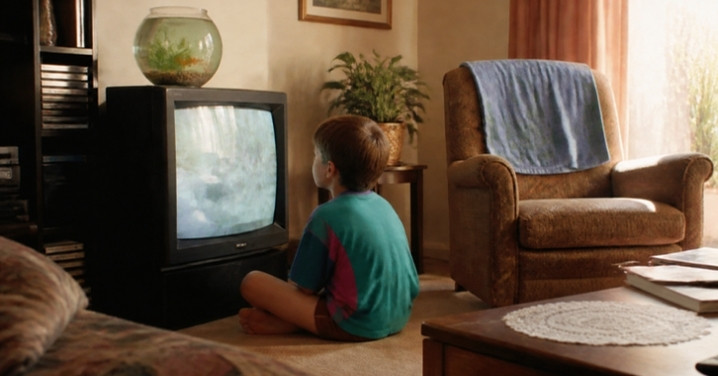
“Don’t sit so close to the TV, you’ll go blind.” This was said in every lounge in the country while we sat cross-legged on the carpet, roughly eleven centimetres from the screen, watching Saturday morning cartoons.
Same with reading under the covers with a torch. Every bookish child in South Africa was apparently on the fast track to thick glasses.
The truth is kinder. Sitting close to a screen or reading in dim light can tire your eyes and give you a headache, but there’s no evidence it causes lasting damage. Children can also focus up close more easily than adults, which is probably why they kept shuffling forward in the first place.
So no, the TV didn’t ruin your eyesight. If anything did, it was scrolling on your phone in bed at 1am, and we both know that one’s on you.
Then the carrots.
We were told to eat our carrots so we could see in the dark. Some of us took this very seriously and sat in dark bedrooms after supper, squinting at the cupboard, waiting for the superpower to kick in.
It never did, and there’s a reason. The carrot story was boosted by World War II British propaganda. The Royal Air Force was shooting down enemy planes at night with the help of new radar technology, and they didn’t want anyone to know. So the story went around that their pilots were simply eating loads of carrots.
Carrots do give your body what it needs to make vitamin A, which your eyes genuinely need. But if you’re already getting enough, eating more won’t turn you into an owl.
Which means an entire generation of children ate soggy cooked carrots with a sad knob of butter because of a military cover story. Honestly, that’s the most South African childhood detail of all. Doing something mildly unpleasant because a grown-up said so, with no follow-up questions allowed.
Speaking of grown-ups saying so, let’s talk about wet hair.
“Don’t go outside with wet hair, you’ll catch a cold.” This was gospel. Mums would chase children through the house with a towel like it was a fire drill.
Colds are caused by viruses. You catch one by coming into contact with the virus, usually from another person, not from the weather or the state of your hair.
The reason we get more colds in winter has a lot to do with everyone being crammed indoors together, breathing on each other, huddled around the same heater, arguing over the remote.
So wet hair was never the problem. Your cousin who sneezed into the chip bowl at Sunday lunch was the real threat.
While we’re up there, you were probably also told that you lose most of your body heat through your head. This led to beanies being forced onto children every July with the full force of parental law.
Heat loss is roughly in proportion to how much skin is exposed. Your head isn’t a magical chimney. The myth seems to trace back to an old military experiment where people were sent into the cold wearing insulated suits but nothing on their heads. Well, obviously that’s where the heat went. It was the only thing sticking out.
Wear the beanie anyway. It’s still winter on the Highveld, and the Highveld doesn’t care about science.
Then there was gum.
If you swallowed your gum as a child, someone would gasp like you’d just eaten a live bullet. “That’s going to stay in your stomach for seven years.”
Seven years! That’s longer than primary school. We pictured little pink blobs of Chappies sitting in our tummies, slowly gathering into one giant ball, waiting to be discovered by a surgeon in 2009.
Your body can’t break gum down the way it does food, but it still moves through your system and leaves in a few days, like anything else you can’t digest.
The gum did not stay. The gum moved on. Sadly, the “Did You Know?” facts from the Chappies wrappers did stay, and I still remember most of them.
Then the watermelon seeds. Every December holiday at the coast, some uncle would watch a child swallow a pip and say, “Now you’ve done it. There’s going to be a watermelon growing in there.”
Children went to bed in genuine fear of becoming produce.
It doesn’t happen. Your stomach is not a vegetable garden. The seeds pass straight through. The uncle was just bored.
Now let’s talk about knuckles.
Every classroom had one kid who cracked their knuckles all day long. And every classroom had one adult who said, “You’ll get arthritis.”
Studies haven’t found a link between knuckle cracking and arthritis. One doctor, Donald Unger, made it his personal mission to find out. He cracked the knuckles on only one hand for around sixty years, left the other alone, and then compared them. Neither hand developed arthritis.
That man spent six decades proving his mother wrong. That isn’t just science. That’s commitment. That’s a man who heard “you’ll get arthritis” one too many times and decided to settle it properly.
It’s still annoying, though. Science never said anything about the sound not being annoying.
Next, shaving.
Teenage boys were told not to start shaving too early because the hair would come back thicker and darker. Teenage girls were told the same thing about their legs. Entire puberty strategies were built around this rule.
Shaving doesn’t change the thickness, colour or speed of hair growth. It cuts the hair off with a blunt tip, so the stubble feels coarser. New hair also hasn’t been lightened by the sun yet, so it can look darker for a while.
So the regrowth was never a beast. It was just a fresh haircut for your shins.
And then there’s one straight out of the sleepover horror files: hair and nails keep growing after you die.
This was usually shared at midnight with a torch held under someone’s chin.
They don’t. What actually happens is that the skin dries out and pulls back, which makes the hair and nails look longer. It’s a bit grim, but far less grim than picturing your ancestors quietly growing out their fringes.
Now let’s go to school, because the teachers don’t escape this audit either.
Remember the tongue map? It was in every science textbook. A drawing of a tongue divided into zones, sweet at the tip, salty and sour on the sides, bitter at the back.
We even did experiments. We dabbed sugar water on different parts of our tongues with ear buds, got results that didn’t really match the map, and wrote down what the map said anyway because we wanted the marks.
The tongue map is wrong. Every part of the tongue with taste buds can pick up all the basic tastes. The map came from a German paper published in 1901 that was misread and oversimplified, then copied from textbook to textbook for decades.
So every child who confidently wrote “bitter is tasted at the back of the tongue” in a test got a tick for being wrong. Education is a beautiful thing.
Then there were learning styles.
At some point, a lot of us were sorted into visual, auditory or kinaesthetic learners. Some of us filled in a little questionnaire. Some of us were genuinely proud of our label. “I’m a visual learner,” we’d say, like it was a star sign.
People do have preferences. But research hasn’t shown that teaching people according to their supposed style helps them learn any better. A major review in 2008 found no solid evidence for it.
Which means many of us spent years believing we couldn’t learn something because it wasn’t presented “our way.” Turns out you probably could have. You just didn’t feel like doing the homework. Same as everyone else.
While we’re inside the brain, let’s deal with the most famous one of all: we only use 10% of our brains.
Every dramatic movie trailer and every slightly mystical aunt loved this one. Imagine what you could do if you unlocked the other 90%. Telekinesis. Fluent French. Finally understanding how a parking meter works.
Sadly, brain scans show activity across almost the whole brain. Different areas handle different jobs at different times, but there’s no sleeping 90% waiting to be switched on. Even while you sleep, your brain is busy.
So you’re already using all of it. Yes, even when you put the milk in the cupboard and the cereal in the fridge.
Closely related is the left brain versus right brain personality idea. Logical people were left-brained, creative people were right-brained, and everyone found out which one they were from a quiz in a magazine.
The two halves of the brain do specialise in some tasks. But brain scans haven’t shown that people favour one side overall, or that it shapes who you are. You’re not half a brain. You’re a whole, gloriously chaotic one.
Then there was history class.
We learned that Christopher Columbus sailed off to prove the world was round, while everyone back home was convinced he’d sail straight off the edge.
Educated Europeans already knew the earth was round. People had known since ancient Greece. The flat earth version of the Columbus story was spread largely by an 1828 biography of Columbus by Washington Irving, who was, it must be said, a storyteller. He also wrote The Legend of Sleepy Hollow. So that tracks.
Napoleon was supposedly tiny, which is why every short, bossy man was nicknamed “Napoleon” in the staff room. In reality he was about 1.69 metres tall, which was average or a little above for a Frenchman of his time. The confusion came partly from French and British inches being different lengths, with some help from British cartoonists who loved drawing him as a cranky toddler.
And the Vikings, who we all drew with horned helmets in Grade 5 art. There’s no archaeological evidence they wore them. The horns largely come from costume designs for a Wagner opera production in 1876. So our image of the Vikings was basically shaped by a theatre wardrobe department. As a theatre person, I find this deeply satisfying.
Then there’s the Great Wall of China, which we were told you could see from space. You can’t, not with the naked eye from orbit. China’s own first astronaut, Yang Liwei, said in 2003 that he couldn’t see it. If he couldn’t spot his own country’s wall, the rest of us don’t stand a chance.
And then, my favourite school myth of all, and a very Southern Hemisphere one. The toilet.
Somebody, at some point, told you that toilets here flush the opposite way to toilets in the Northern Hemisphere. Some of us even saw the famous videos of a man at the equator swirling a basin of water on one side of a painted line, then the other, and the water changing direction like magic.
The effect behind that idea is real for huge things like weather systems, but it’s far too weak to affect something as small as a toilet bowl or a basin. What decides the swirl is the shape of the bowl and the angle of the water jets.
So the next time someone at a party says, “Did you know toilets flush the other way here?”, you can now ruin their evening. You’re welcome.
And blood. We were taught, or at least strongly led to believe, that blood is blue inside your body and only turns red when it hits the air. Those science diagrams with blue veins and red arteries didn’t help.
Blood is always red. Blood carrying less oxygen is just a darker red. Veins look blue because of the way light travels through your skin and bounces back. So you’re not a Smurf on the inside. You’re just a slightly moodier shade of red.
Let’s move on to the animals, where honestly, the myths got wild.
Goldfish have a three-second memory, we were told, which is why it was perfectly fine to keep them in a tiny round bowl on the TV cabinet. Every lap was a brand new adventure.
Goldfish can remember things for months. They can be trained to respond to sounds, colours and feeding times.
Which means every goldfish that ever lived on a South African TV cabinet in 1994 knew exactly how small its bowl was. I’m sorry. I’m so sorry.
Then there was the bull and the red cape. We grew up thinking bulls were furious at the colour red, like a very aggressive fashion critic.
Bulls can’t see red well at all. They charge because the cape is moving. You could wave a yellow cape, a green cape, or the floral tablecloth from Ouma’s dining room, and the bull would charge it all the same.
Baby birds were another one. If you found a fledgling on the lawn, you were told not to touch it, because the mother would smell humans on it and abandon it.
Most birds have a poor sense of smell and won’t reject a chick because a human touched it. There are still good reasons to leave wild birds alone, mostly because fledglings are often meant to be on the ground with their parents nearby. But the mother bird isn’t sniffing it like a suspicious aunt at a family reunion.
Bats are blind, we were told. That’s where “blind as a bat” comes from.
All bats can see, and some see very well. Many of them also use echolocation, which is basically built-in sonar. So bats aren’t blind. They just have an extra feature you don’t.
Dogs supposedly only see in black and white. Every family dog was imagined living in a sad, colourless world, like an old movie.
Dogs do see colour, mostly blues and yellows, similar to how someone with red-green colour blindness sees the world. So your dog can see that tennis ball just fine. It just doesn’t care what colour it is. It cares that it’s a ball.
Chameleons change colour to blend into their surroundings, we were told, and many of us tried to prove it by placing an unlucky chameleon on a tartan blanket.
They actually change colour mostly to communicate and to control their temperature. Matching the background is more of a side effect. So that chameleon on the tartan wasn’t failing at camouflage. It was having feelings.
And ostriches don’t bury their heads in the sand. They lower their heads to the ground to turn their eggs, or to lie low and avoid being spotted. From a distance it looks like the head has disappeared. As South Africans, we really should have known this one. We have a lot of ostriches.
Some myths came from general grown-up folklore.
Lightning never strikes the same place twice. Except it does, often. Tall buildings get hit again and again, and some skyscrapers are struck many times a year. If anything, lightning has favourite spots.
Never wake a sleepwalker, because the shock could kill them. It isn’t dangerous. They might be confused or a bit cross, but gently guiding them back to bed is generally seen as safer than letting them wander around the house, opening the fridge in the dark like a ghost looking for snacks.
Alcohol warms you up. Every uncle at every winter braai lived by this one. A brandy and Coke was considered a jacket.
It makes you feel warm because it widens the blood vessels close to your skin, but that actually helps your body lose heat faster. So the uncle at the braai felt lovely and cosy while, scientifically speaking, getting colder. Which explains the next part of the evening, when he stood far too close to the fire.
Then there’s drinking exactly eight glasses of water a day. This wasn’t really a childhood rule. It was a nineties and 2000s wellness rule, printed in magazines, repeated in offices, and enforced by people carrying enormous water bottles.
There’s no scientific basis for that specific number. How much water you need depends on your size, how active you are and the weather, and your food and other drinks count towards it. Drink when you’re thirsty. Drink more on a hot Joburg afternoon. You don’t need to count glasses like someone marking days on a cell wall.
And finally, old windows. If you ever looked at a very old church window, someone probably told you the glass was thicker at the bottom because glass is secretly a very slow liquid that’s been dripping downwards for centuries.
It’s a lovely idea, and it isn’t true. Old glass-making methods produced panes of uneven thickness, and builders often put the thicker edge at the bottom because that’s simply sensible. The glass didn’t move. The builders were just practical.
So here’s the thing.
When you read a list like this, it’s tempting to feel a little betrayed. All those years on the edge of the pool. All those beanies. All those dark bedrooms waiting for carrot vision to arrive.
But I don’t think these myths survived because people were silly.
I think they survived because they were passed down with love.
Nobody told you to wait thirty minutes before swimming because they wanted to ruin your afternoon. They told you because someone once told them, and they wanted you safe.
The wet hair warning really meant “I don’t want you to get sick.” The carrots meant “please eat something with a vitamin in it.” The TV warning meant “please go outside and get some sun.”
Most of these myths were just care, wearing the wrong outfit.
They were also a way of sharing a world with someone. Your gran told your mum, your mum told you, and for a while, the whole family believed the same slightly wrong thing together. There’s something sweet in that. A shared family rulebook, full of mistakes, held together by people who were trying.
The world we grew up in didn’t have Google in everyone’s pocket. If Ouma said it, it was fact. If it was on a poster in the science classroom, it was fact. If your friend’s older brother said it with enough confidence, it was absolutely, unquestionably fact.
Now anyone can check anything in about four seconds. That’s a wonderful thing. But I think we lost a little of the magic of believing the grown-ups knew everything.
So the next time you catch yourself telling a child to wait half an hour before swimming, or chasing someone down the passage with a towel, or shouting at a kid for sitting too close to the TV, stop for a second.
Then decide whether to correct yourself.
Or whether, for just one more generation, you’ll keep the tradition going. For old times’ sake.
Just maybe let them swim.