

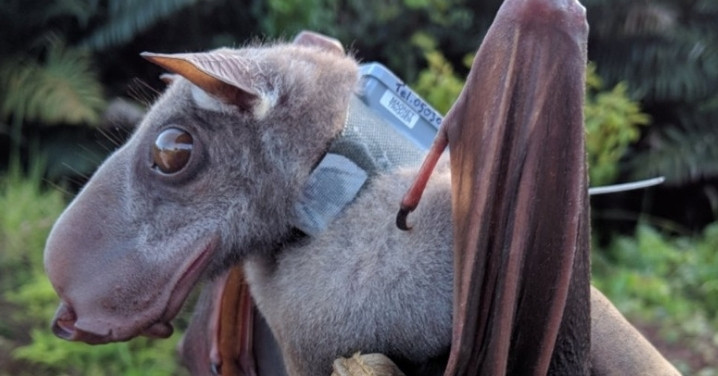
Header photo: <a href="https://commons.wikimedia.org/wiki/File:Hypsignathus_monstrosus_2.png" target="_blank" rel="noopener">Sarah H. Olson et al., via Wikimedia Commons</a> (CC0)
Every now and then the internet hands you an animal so strange that you have to put your phone down, stare at the wall for a moment, and then pick the phone back up to make sure you didn’t imagine it.
For me, that animal is the hammer-headed bat.
I’m not exaggerating when I say it looks like someone tried to make a bat out of Play-Doh, got distracted halfway through, and left the face to slowly melt in the sun.
It has a big, boxy, slightly droopy head. It has lips that seem to belong to a much larger, much more dramatic creature. It has the expression of someone who has just been told the Wi-Fi is down for the whole weekend.
And I adore it. Completely. Unreservedly. Squishily.
So let me introduce you to Africa’s honking, big-lipped, wonderfully weird fruit bat, and explain why it deserves a lot more love than it gets.
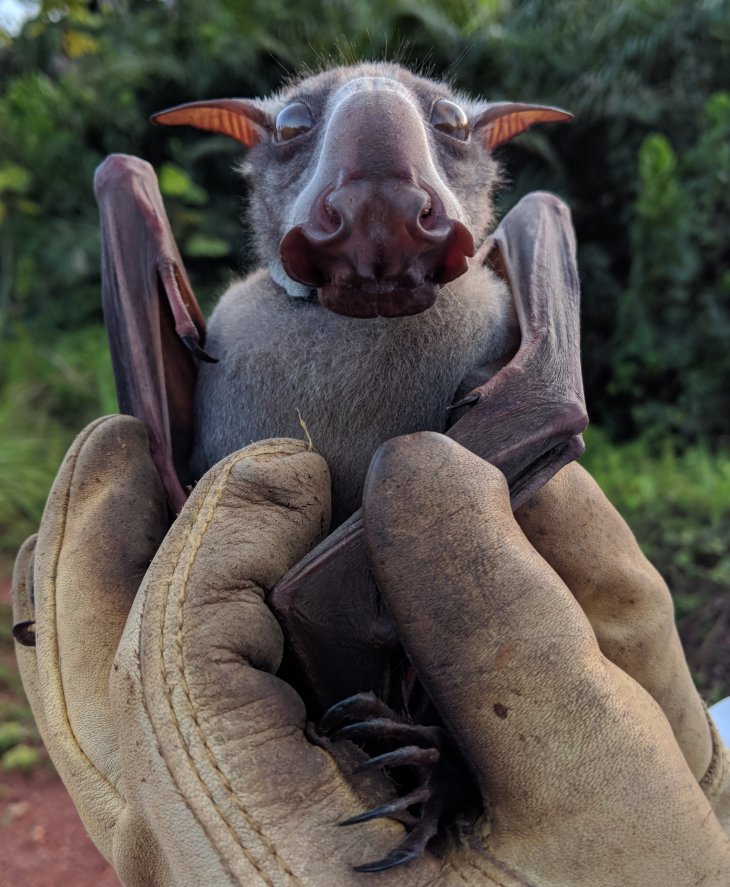
First, the name. The scientific name of the hammer-headed bat is Hypsignathus monstrosus.
The “monstrosus” part is Latin and basically means “having the qualities of a monster.”
Imagine being so odd-looking that the scientist naming you went, “Yes, monster. That’s the vibe.”
The species was officially described in 1861 by an American scientist named Harrison Allen. The first specimen was collected in Gabon by the explorer Paul Du Chaillu, who, judging by the name that ended up on the paperwork, did not return home describing it as “rather sweet.”
It goes by a few other names too. Hammerhead bat, hammer-headed fruit bat, and my personal favourite, the big-lipped bat.
Which honestly sounds like the name of a jazz club in Maboneng that only opens after midnight.
Now, before you picture something tiny and squeaky, let’s talk about size.
The hammer-headed bat is the largest bat in mainland Africa. Its wingspan can get close to a metre.
A metre. That’s roughly the width of your front door. Picture opening the door one evening and finding that on the other side, wings out, lips first.
The males are much bigger than the females. On average, an adult male weighs around 420 grams, while a female averages around 234 grams. So the boys can be close to double the weight of the girls.
And that brings us to the reason this bat is so famous in biology circles. It’s thought to be the most sexually dimorphic bat in the world.
That’s a fancy way of saying the males and females look wildly different.
The females look like fairly normal fruit bats. They have neat, narrow, fox-like faces. If you saw one hanging in a tree, you’d think, “Oh, cute, a bat,” and carry on with your day.
The males look like the females put on a novelty Halloween mask and then forgot to take it off. For several generations.
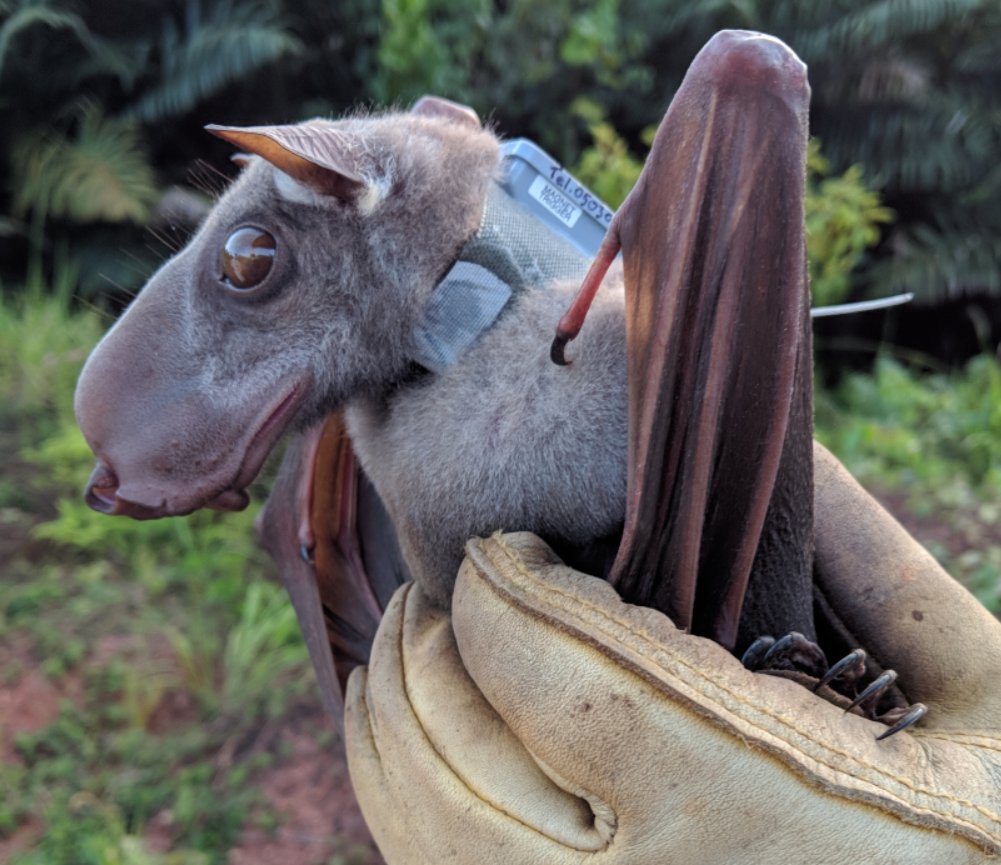
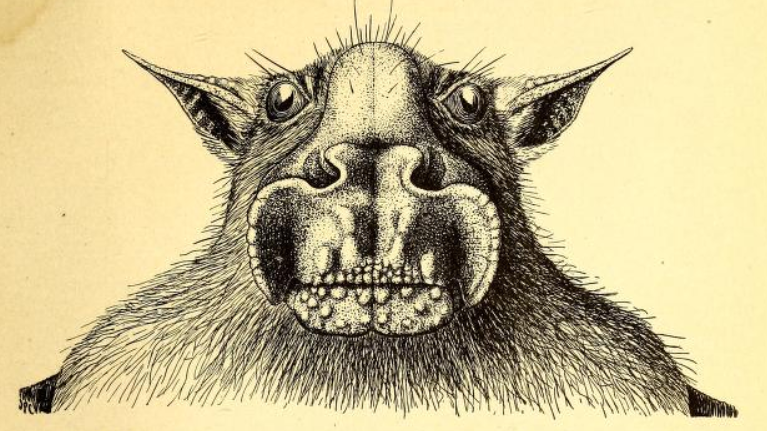
The male hammer-headed bat has a huge, square head, a swollen, humped snout and enormous, floppy lips. Up close, the face has a kind of rubbery, folded, squishy quality, like a stress ball that’s been squeezed one too many times during a budget meeting.
But here’s the thing. That face isn’t just a face. It’s a sound system.
Inside the male’s snout is a large sinus, and connected to his throat are air sacs that work like resonating chambers. The whole head is essentially built to make noise louder.
And then there’s the voice box.
This is where the hammer-headed bat goes from “weird” to “how is this even allowed.”
The male’s larynx, which is the voice box, is about three times the size of the female’s. It’s so big that it stretches through most of his chest cavity and reaches about half the length of his spine.
It is so large that it physically pushes his other organs out of the way. His heart, his lungs and his digestive system have all had to shuffle aside to make room.
Let that sink in. This bat has rearranged its entire body so it can be louder.
Back in the early 1900s, two naturalists named Herbert Lang and James Chapin studied these bats in the Congo, and they summed it up perfectly. They wrote that “in no other mammal is everything so entirely subordinated to the organs of voice.”
Which is the most elegant way anyone has ever said, “This animal is basically a walking speaker.”
Lang and Chapin were part of the American Museum of Natural History’s Congo expedition, which ran from 1909 to 1915. That’s six years in the rainforest, collecting, sketching and photographing everything they could find.
And out of everything they saw in those six years, this bat still managed to make them stop and write something that dramatic.
I love the idea of two very serious, very moustached gentlemen in pith helmets, sitting by a lantern in the middle of the jungle, trying to keep a straight face while a hundred of these creatures honked at them all night.
Some of their old photographs and drawings are now in the public domain, which means we can still look at exactly what they saw. And the bats look just as baffled and squishy over a hundred years later.
The skull is pretty remarkable too. The hammer-headed bat’s skull is larger and sturdier than that of any other African fruit bat, which makes sense. You need solid scaffolding if you’re going to build a concert hall on your face.
So what is all that noise for? Love, darling. It’s always love.
Hammer-headed bats are famous for their dating system, which scientists call a lek.
A lek is basically an outdoor talent show where the males gather in one place, show off as hard as they possibly can, and the females wander through and choose who they like.
Birds do this a lot. Think of grouse or certain birds of paradise strutting their stuff. But among bats, the hammer-headed bat is believed to be one of the only species, possibly the only one, with a classic lek.
Here’s how it works.
During the mating season, the males gather along a stream or a riverbed. A single lek can have anywhere from about 20 to 135 males lined up along a strip of forest that can stretch for hundreds of metres, even more than a kilometre and a half.
Each male claims his own little patch of stage, about 10 metres across. He hangs from a branch, flaps his wings, and honks.
And honks.
And honks.
He can honk somewhere between 60 and 120 times a minute. That’s up to two honks every second, for hours.
The males display like this for roughly four hours before they go off to find food, with the busiest honking in the early evening and again before dawn.
If you’ve ever been stuck in Joburg traffic on a Friday afternoon, you already have a good idea of what a hammer-headed bat lek sounds like. Except the bats are more organised and nobody is driving on the shoulder.
Meanwhile, the females fly up and down the line, listening and judging, like the strictest panel on a singing competition.
When a female finally decides, she lands on the branch right next to the male she’s chosen.
And he, overwhelmed with joy, makes a different sound. Scientists describe it as a “staccato buzz.”
I think about that buzz a lot. After hours of honking his heart out, the moment he gets picked, he basically vibrates with excitement. Honestly, relatable.
Now for the slightly brutal part.
The competition is fierce. In one study, the top 6% of males were responsible for 79% of the matings.
So a tiny handful of absolute superstar honkers get almost all the attention, while the rest of the lads hang there all night, flapping and honking into the void.
It’s the bat version of a group chat where one person’s message gets fifty replies and yours just gets “seen.”
Interestingly, not every population does things this way. Some hammer-headed bats in West Africa skip the lek entirely and use more of a harem system instead. Even in the bat world, not everyone wants to do the big public show.
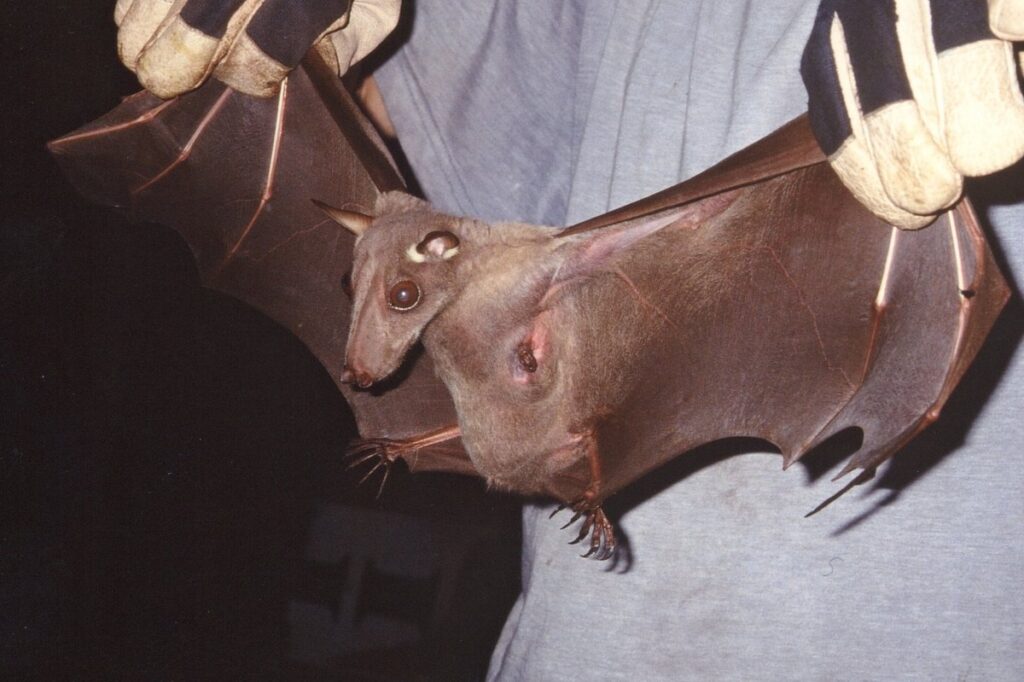
Let’s talk about food, because this monster of a bat is, in fact, a fruit lover.
Hammer-headed bats mainly eat figs. They also go for mangos, bananas and guavas.
And their table manners are fascinating. They chew the fruit, swallow the juice and the soft pulp, and then spit out the rest. A kind of very fancy, very messy smoothie situation.
They even have a special tongue for the job. It has an expanded, three-pointed tip and tiny backward-facing bumps that help squeeze the juice out of the fruit.
Because fruit isn’t very high in protein, scientists think these bats may make up for it with a proportionally longer gut, so they can squeeze every bit of goodness out of what they eat.
Here’s the lovely part. Because seeds pass through and end up in their droppings, hammer-headed bats may help plant new trees across the forest. So all that messy eating and honking is quietly helping the rainforest grow.
Now, I do have to mention the strangest report about their diet.
Back in 1968, a researcher reported hammer-headed bats attacking chickens to drink their blood and scavenging meat.
I want to be very clear here. This is one old report, and these bats are overwhelmingly fruit eaters. But I’d be lying if I said that sentence didn’t make me look at that squishy face a little differently.
It’s the same energy as finding out your gentle, plant-loving aunt once got into a fight at a car boot sale.
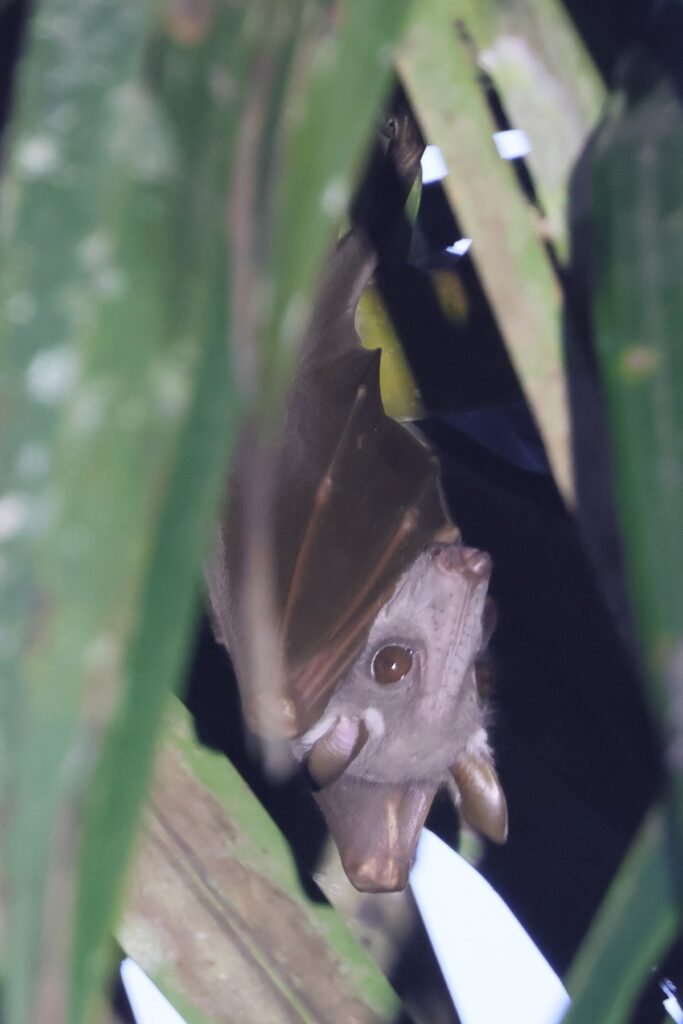
When they’re not honking or eating, hammer-headed bats are surprisingly low-key.
They roost high up in the forest canopy, usually 20 to 30 metres above the ground. They move to a new roost every five to nine days, so they’re basically the forest’s serial Airbnb guests.
During the day they sleep with their noses tucked under their wings. Which means that the very feature that makes them famous is politely put away while they nap. Like taking off your statement earrings before bed.
They usually hang out alone or in small groups of about four, although groups of up to 25 have been recorded. In those groups, the bats hang about 10 to 15 centimetres apart, and the males tend to position themselves on the outside.
I like to think the males are on the outside because they’re protective. Realistically, it may just be because their heads need the extra space.
And then there’s a bit of biology that genuinely made me sit up.
Most mammals have X and Y sex chromosomes. Hammer-headed bat males don’t have a Y chromosome at all. They have a single X and that’s it. As a result, the females have 36 chromosomes and the males have 35.
This bat is so committed to being unusual that it’s weird all the way down to its DNA.
The babies, by the way, are tiny compared to the adults. Newborns weigh around 40 grams, which is about the same as a small handful of grapes.
The females grow up fast. They can breed at about six months old and reach adult size by nine months. The males take a lot longer, only reaching maturity at around 18 months.
Which, if you’ve ever met a teenage boy, will not surprise you at all.
So where can you actually see one?
Not in South Africa, sadly. The hammer-headed bat lives in the rainforests of West and Central Africa, in countries like Gabon, Cameroon, the Republic of the Congo, the Democratic Republic of the Congo, Ghana, Nigeria and Uganda.
They like lowland rainforest, swamp forest and forest along rivers, which makes sense when you remember they need a nice long riverbank to hold their honking contests.
But South Africa isn’t completely left out of the family drama.
The hammer-headed bat belongs to a group of fruit bats that includes the epauletted fruit bats, and one of those, Wahlberg’s epauletted fruit bat, lives in the eastern parts of our country, including KwaZulu-Natal.
In fact, that species was first described from a specimen collected near Durban back in the 1840s.
The males of that species also call from the trees at night to attract females, with a loud, repetitive, one-note call, and they puff up air sacs on their necks to help with the volume. So if you’ve ever lain awake in a Durban holiday flat, listening to a strange, repetitive chirping coming from the trees outside, there’s a chance you were listening to a distant cousin of the hammer-headed bat doing a much more polite version of the same thing.
The South African branch of the family clearly went to finishing school. The Central African branch went to drama school.
And I respect both choices.
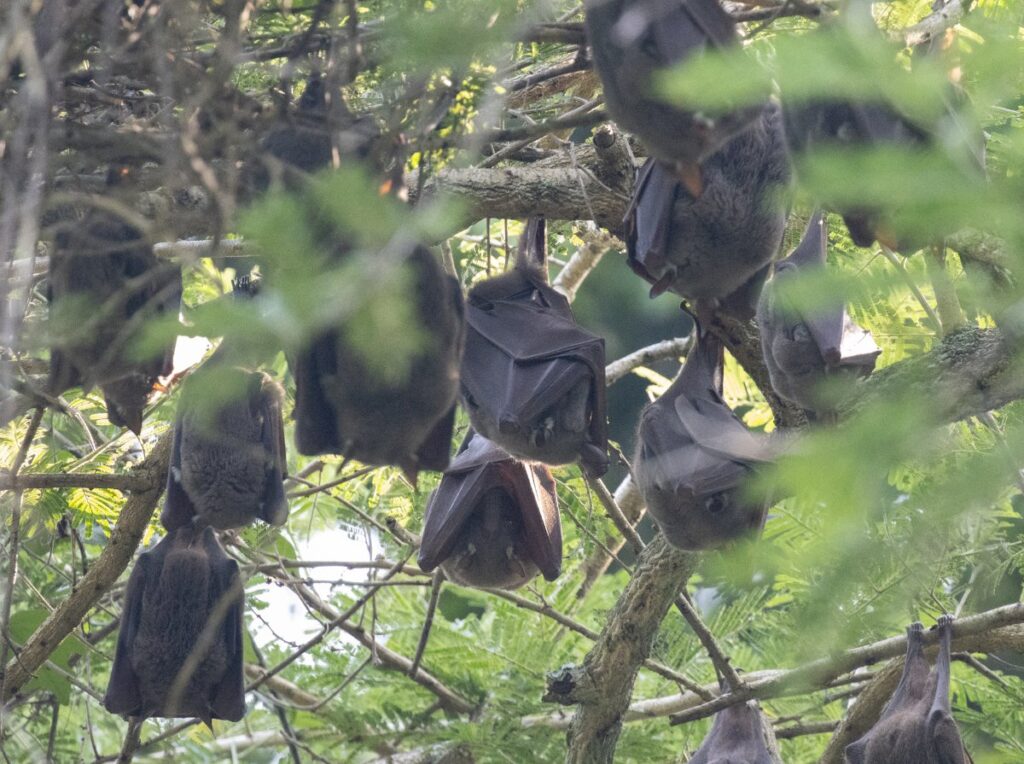
Hammer-headed bats aren’t considered endangered. The IUCN lists them as Least Concern, because they have a wide range and are thought to have a large population.
That doesn’t mean life is easy for them. In some places they’re hunted for food. Some farmers see them as pests because they eat fruit crops. And plenty of people living near a lek simply consider them a nuisance, because, well, imagine trying to sleep next to a hundred bats honking twice a second.
I’ve complained about a neighbour’s dog barking at 2am. I’m not sure I’d survive a hammer-headed bat lek.
There’s also a more serious side to their story.
Hammer-headed bats have been studied as one of several possible natural hosts of the Ebola virus. Some bats have been found with antibodies, and fragments of the virus’s genetic material have been found in their tissue, but scientists have not confirmed them as the source, and the natural host of the virus was still unknown as of 2019.
Which is exactly why the photos of these bats being handled show researchers wearing thick protective gloves. And it’s a good reminder that as squishy and lovable as they look, wild bats are not for cuddling. Admire them from a distance. Preferably through a screen. With a snack.
Interestingly, that research is also why some of the best photos of these bats exist. In 2017 and 2018, scientists working in northern Republic of the Congo fitted hammer-headed bats with small solar-powered GPS collars to track how they moved around a lek, which is how we got that wonderful side profile of a male wearing what looks like a very small, very serious backpack.
They’re also notoriously tricky to keep in zoos. The males in particular are prone to stress-related illness, especially when they’re moved somewhere new.
Honestly, same. I also become a completely different person when someone changes my routine.
If you’ve spent any time online, you’ll know there’s a whole category of animals that live in the beautiful space between ugly and adorable.
The blobfish. The naked mole-rat. The aye-aye. Any pug that has ever existed. Moo Deng, the tiny pygmy hippo who became the internet’s spokesperson for being dramatic and slightly unhinged.
The blobfish even got voted the world’s ugliest animal back in 2013, in a public vote run by a group called the Ugly Animal Preservation Society, which is honestly the best organisation name I’ve ever heard.
The hammer-headed bat belongs firmly in that club. Possibly as the founding chairperson.
There’s something about these ugly-cute creatures that makes us want to protect them. They’re imperfect in a way that feels honest. They don’t look like they’ve been through a filter. They look like they rolled out of bed, didn’t check a mirror, and went about their business anyway.
And I think part of us really envies that.
Because let’s be honest, most of us have at least one feature we’ve spent years being a bit self-conscious about. A nose. A laugh. A voice that carries further than we’d like at a quiet dinner party.
The hammer-headed bat has all of those things at maximum volume, and it doesn’t seem bothered in the slightest.
So why am I so obsessed with this bat?
Partly, of course, because it’s ridiculous. It has the face of a deflated hand puppet, the voice of a vuvuzela and the dating life of a reality TV show. It is pure, unfiltered internet gold.
But the more I read about it, the more I found something oddly touching underneath all the weirdness.
This is an animal that has rebuilt its entire body around one thing. Its voice.
The giant head, the floppy lips, the inflatable air sacs, the voice box so big it shoves its own heart out of the way. All of it exists so that, once or twice a year, a male can hang from a branch by a river and shout into the dark, “Here I am. Please notice me.”
That’s not monstrous at all. That’s one of the most human things I’ve ever heard.
We spend so much time trying to smooth ourselves out. Trying to be quieter, neater, more palatable, less much. Trying to fit the version of beautiful that’s been handed to us.
The hammer-headed bat looked at all of that and said, “No thanks. I’m going to be enormous, lumpy, squishy and very, very loud.”
And somewhere in the dark, someone flies past, hears that honk, and chooses him anyway.
Maybe even because of it.
So here’s to the hammer-headed bat. The big-lipped, honking, gloriously weird hero of the African rainforest.
May we all find someone who lands on our branch and buzzes back.