
Valentine’s Day can seem like an unusual celebration, especially when you consider its activities. On February 14th, people indulge in chocolates, exchange cards, and revel in romantic gestures, and schools often join in the festivities. Though today it’s often seen as a commercialised event, its roots stretch back over two millennia to an ancient Pagan ceremony filled with rituals that would seem out of place in today’s romantic setting.
This ancient ceremony, known as Lupercalia, is believed to be the precursor to Valentine’s Day. The exact origins of Lupercalia are somewhat murky, but it’s thought that many of its customs predate Roman times. It appears that Lupercalia may have evolved from Februa, an older festival aimed at spring cleaning and renewal. The month of February gets its name from Februa, highlighting the connection between these ancient celebrations and the time we now dedicate to love.
What did people do during the Roman festival of Lupercalia?
A group of priests called the Luperci conducted sacrifices, offering goats and dogs to the goddess Juno. This ritual took place in the cave where, according to legend, the she-wolf cared for Romulus and Remus, the city’s mythical founders. Following the sacrificial rites, there was a celebratory feast. The priests would then slice the hides of the sacrificed animals into strips.
Cool, huh? Well, now it gets strange.
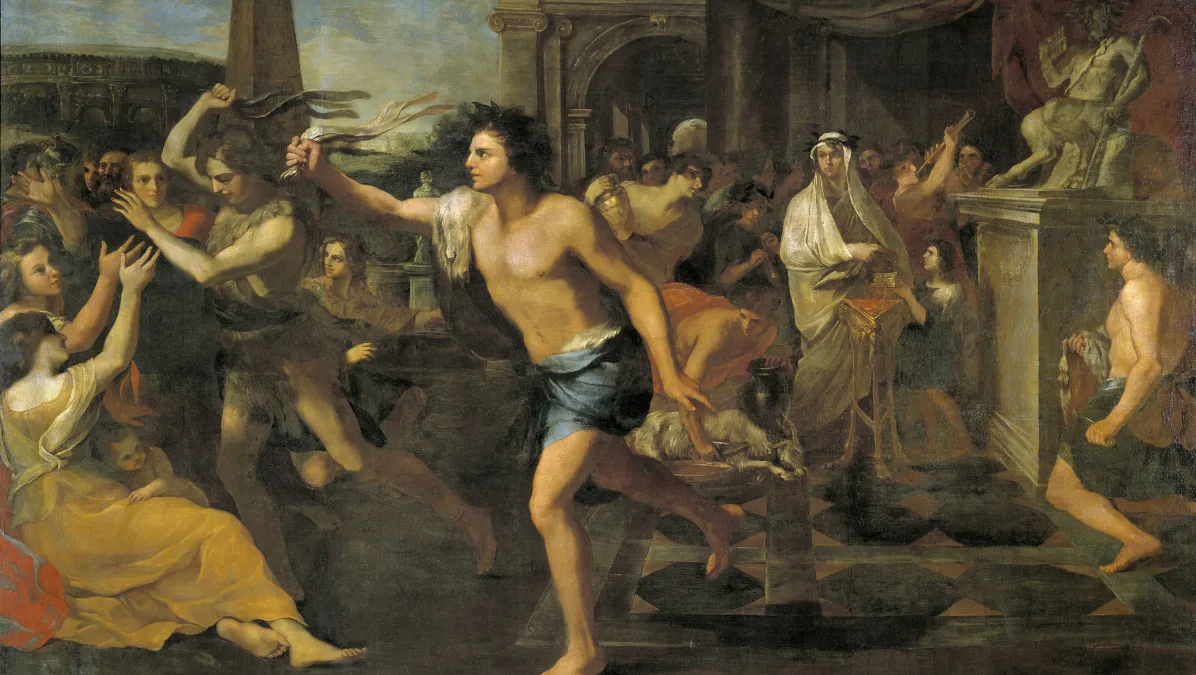
Fertility rituals were a key part of the celebration, where women, in a state of undress, were gently tapped with the animal hide strips while the priests circled the Palatine Hill in an anti-clockwise direction. This practice was believed to enhance fertility and ease childbirth. Following these rituals, a matchmaking draw took place, adding to the festive atmosphere. The occasion was marked by abundant consumption of alcohol. Attire for the attendees was largely discretionary, leading to a common preference for minimal clothing. So nakedness, a lottery of matchmaking and lots and lots of alcohol. Sounds like a part right?
Plutarch, the great Roman historian, described it as such:
..many of the noble youths and of the magistrates run up and down through the city naked, for sport and laughter striking those they meet with shaggy thongs. And many women of rank also purposely get in their way, and like children at school present their hands to be struck, believing that the pregnant will thus be helped in delivery, and the barren to pregnancy.
Many sources corroborate Plutarch’s account, describing how the city buzzed with young men and women engaging in playful chases, lightly tapping each other with strips of animal hide.
Certain rituals from those times carry obscure significance today. For instance, following the animal sacrifices, a pair of Luperci priests would have their foreheads marked with blood using the sacrificial blade. Subsequently, this blood was cleansed with wool dipped in milk, after which they were supposed to respond with laughter or smiles to this ritual.
Lupercalia wasn’t a one-off thing either.
Following the Roman calendar’s inclusion of February, Lupercalia was scheduled for the fifteenth of the month. The festival enjoyed widespread popularity, a fact Julius Caesar exploited to enhance his public image by famously refusing a crown during the festivities. Lupercalia remained a continuous celebration until approximately 500 CE, when efforts to eliminate Pagan practices eventually led to its discontinuation.

Several scholars suggest that Pope Gelasius I played a significant role in diminishing Lupercalia, possibly by introducing a feast of purification on the same date. There are also views that the festival persisted but was infused with Christian elements and more modest attire. Nonetheless, Valentine’s Day, which commemorates a saint executed by the Romans, maintains a similar timing and many romantic aspects of the ancient Lupercalia festival.
Although the precise transition from Lupercalia to Valentine’s Day is unclear, it’s a known practice that the Christian church adapted rather than eradicated many Pagan celebrations. This supports the idea that the two holidays might be connected. Despite this, some historians remain skeptical of the theory that Valentine’s Day was deliberately established to supplant Lupercalia.

How did we go from Lupercalia to St. Valentine’s Day?
Since the medieval period, Valentine’s Day has increasingly embraced a more tender and romantic nature, significantly influenced by literary figures such as Chaucer and Shakespeare, who celebrated the holiday’s courtly love traditions. The earliest known Valentine’s card was dispatched in 1415 by a French noble, and as the holiday gained popularity in America during the revolutionary period, people exchanged handwritten notes. By the 20th century, the production of Valentine’s cards had become a commercial operation.
This gentle celebration stands in stark contrast to the boisterous festivities of ancient Rome. Observing both might lead one to question any connection between Rome’s spirited Pagan fertility rituals and the contemporary Valentine’s Day.
Today, Valentine’s Day might seem like a lighthearted, commercial occasion focused on sweets, sentimental media, greeting cards, and lavish romantic gestures. Yet, its roots trace back to customs far more unrestrained than we could likely envisage. The evolution of holidays and the transformation of traditions can vary widely. The progression from Lupercalia to Valentine’s Day exemplifies how a celebration can maintain its core themes across millennia while completely transforming the manner in which those themes are observed and honoured.
So, enjoy a delightful Valentine’s Day, and perhaps appreciate the simplicity of not having to navigate past scantily clad individuals wielding strips of hide in your holiday festivities.