
Let’s set the scene: you’re lounging on the couch, remote in hand, reminiscing about childhood. You spot a Charlie Brown special and think, “Ah, the good ol’ days of Snoopy dancing and Lucy pulling the football away.” So you settle in, expecting warm nostalgia, but then… BOOM. You remember that theory. Yeah, that one. The one that takes Charlie Brown’s little bald head and turns it into a tragic symbol of existential despair. Ready? Let’s ruin some childhood memories, mate.
Okay, first up—Charlie Brown. He’s not just the loveable underdog who can’t catch a break. Nope. According to this theory, he’s a kid living with terminal cancer. Yeah, let that sink in. That receding hairline? Not just a quirky aesthetic choice by the artist. Nope, it’s a sign of his illness. And his perpetual bad luck? Not because the universe has a vendetta against him, but because his “life” is really just his subconscious grappling with the fact that he doesn’t have much of it left.
And if that wasn’t dark enough, here’s the kicker: everything—his adventures, his friends, his dog—is all an illusion. A daydream. His mind’s way of escaping the reality of his condition. Each missed football kick, every failed attempt at flying a kite, every unrequited love with the little red-haired girl—it’s all his own sadness manifesting into a world that mirrors his inner turmoil.
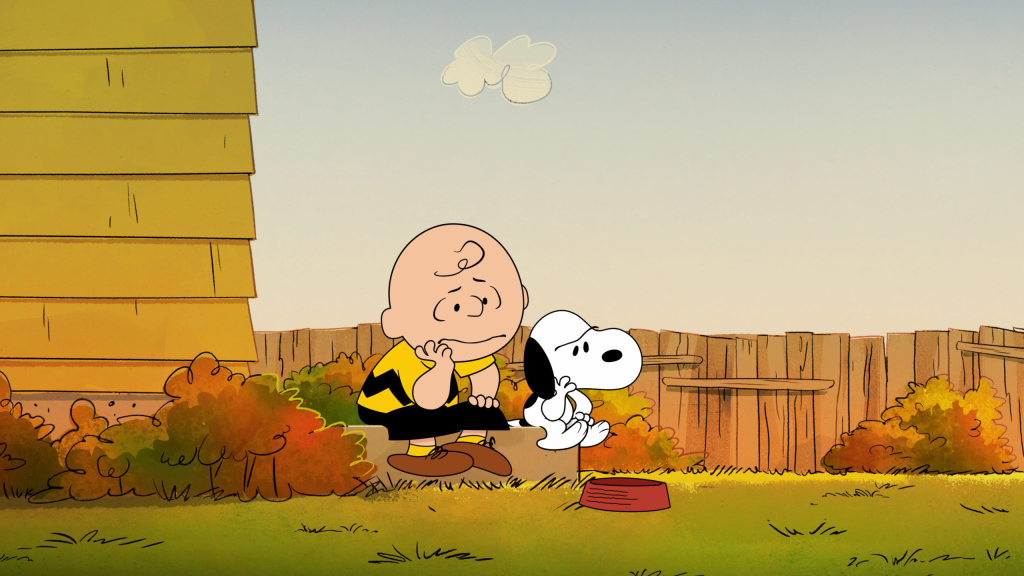
Now, let’s talk Snoopy for a second. Our guy Snoopy is the MVP of Charlie’s life, right? Always there, vibing in his own doghouse, dreaming about being a WWI flying ace. But in this theory? Snoopy isn’t a cheeky dog with a wild imagination. Nope, he’s the manifestation of Charlie’s longing for freedom. Think about it: Snoopy’s wild antics and fantasy flights are everything Charlie wishes he could do. Snoopy’s the “cool guy,” the free spirit that Charlie will never get to be. So every time Snoopy pulls off some madcap adventure, it’s not just for laughs—it’s Charlie dreaming of a life he’ll never live.
And Lucy. Oh, Lucy. The bane of Charlie’s existence. Why is she so harsh? Why is she always yanking that football away? Some theorists reckon she’s not just a bossy kid but represents the harshness of reality itself. Every time she tricks Charlie, it’s like life reminding him that things won’t go his way, no matter how hard he tries. It’s a metaphorical kick in the guts—literally and figuratively.
Then there’s the gang. Linus, with his wisdom and security blanket. Schroeder, who’s laser-focused on his piano. Peppermint Patty, Marcie, the whole crew—they’re all parts of Charlie’s mind. Linus represents comfort. Schroeder? Passion. Patty and Marcie? Friendship and loyalty. They’re the pieces of his life that Charlie wishes were more real, more solid. But no matter how much he interacts with them, they’re just figments of his imagination, swirling around in the soup of his subconscious.
By now, you’re probably thinking, “Alright, this is heavy, but where’s the proof?” Well, there isn’t any, bro. That’s the thing about fan theories—they’re wild, speculative, and just plausible enough to ruin your day. But here’s what really gets people on board with this one: Charlie’s perpetual melancholy. That sense of hopelessness that hangs over him like a rain cloud. He never wins. He never gets the girl. He never even gets to kick that bloody football. It’s the kind of unrelenting sadness that feels bigger than just a bad day at school. It feels existential. Like the kind of despair only someone with a truly tragic backstory could carry.
So, next time you see Charlie Brown trudging around with his “Good grief!” catchphrase, take a moment to think about what’s really going on in that big round head of his. Is he just a loveable loser in a world that won’t cut him a break? Or is he a kid whose mind is creating an entire universe to cope with the heartbreak of his reality?
Either way, watching It’s the Great Pumpkin, Charlie Brown will never feel the same again. You’re welcome.