

The ocean has always been the ultimate stage for nature’s strangest experiments. It’s like evolution took one look at the dark, pressurised depths and said, “Let’s get weird.” You’ve got sharks that glow, squids with built-in headlights, and worms that decapitate fish with rainbow jaws. But standing proudly, or rather floating eerily, in the middle of this marine freak show is a fish so baffling it makes you question whether reality has been hacked. Meet the barreleye fish, the alien you don’t need a telescope to find, only a submarine and nerves of steel.
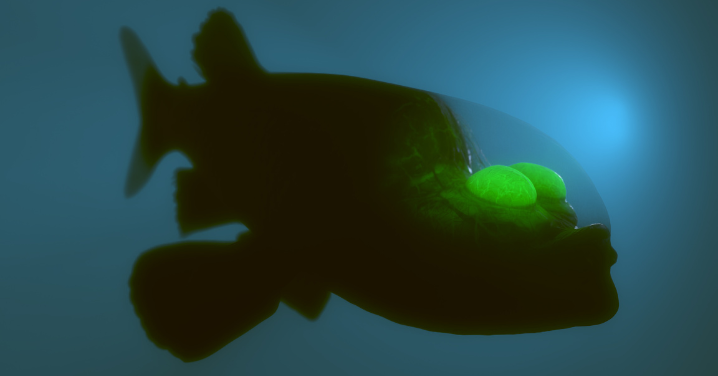
The barreleye fish, or Macropinna microstoma if you want to impress people at parties, has the audacity to walk—well, swim—around with a transparent head. You can literally see into its skull. Forget X-rays, forget MRI scans, this fish comes factory-issued with a glass dome that shows off its inner workings like a biological showroom. At first glance, its body is nothing special: a small, torpedo-shaped shadow drifting quietly in the water, averaging about 15 centimetres in length. Then you look at the head and realise you’re staring into a tiny aquarium of brain and eyes floating inside a clear dome. It’s unsettling, hilarious, and breathtaking all at once.

Those eyes, by the way, are not where you’d think they are. The little black dots on its “face” that look like eyes? Those are its nostrils. The real eyes are the glowing, neon-green tubes staring upward from inside the dome. Yes, tubes. They don’t look like regular eyes at all. They look like someone installed two periscopes inside the fish’s forehead and then forgot to finish the job. For decades, even scientists were confused about this, thinking the eyes faced forward because most of the dead specimens pulled up in nets had collapsed domes. It wasn’t until 2004 that the Monterey Bay Aquarium Research Institute filmed a live barreleye in its natural environment and discovered the truth. The eyes are mobile. They swivel. Normally, they point upward to scan the dim water above for prey silhouetted against the faint glow of sunlight. But when the fish locks onto food, those tubular eyes roll forward into position with the mouth. Imagine having eyes like telescopes inside your head that could spin ninety degrees to help you grab a snack. Disturbing? Absolutely. Brilliant? Without a doubt.
And speaking of snacks, what does a transparent-headed fish eat? Small crustaceans, plankton, and whatever unlucky morsels drift by. The barreleye doesn’t chase prey like a shark on a caffeine rush. It hovers. It floats motionlessly in the water like a creepy little drone, its large fins holding it steady, eyes aimed upward, waiting. Patience is the name of the game when you live 600 to 800 metres below the surface in the twilight zone of the ocean. Down here, sunlight barely penetrates, everything moves slowly, and energy conservation is survival. When something edible drifts overhead, the barreleye swivels its eyes, flicks its fins, and quietly nabs dinner.
Its dome is not just for show. That fluid-filled bubble protects the delicate eyes as the fish noses around stinging jellyfish, because yes, the barreleye occasionally munches on them too. While other creatures get zapped into oblivion, the barreleye floats through tentacles like it’s wearing an astronaut helmet, plucking prey with impunity. It’s like nature said, “What if we gave a fish an invisible riot shield and let it stroll through the jellyfish rave?” and then shrugged when it worked. The transparent dome also helps gather more light, allowing those sensitive eyes to soak in every photon in an environment that’s basically underwater twilight forever. And those green pigments inside the eyes? Filters. They block out the faint sunlight from above so the fish can focus on spotting the faint glimmer of bioluminescent creatures below. While we’d be bumping around in total darkness, the barreleye sees neon dinner plates floating in high-definition.
Of course, a fish that looks this bizarre has attracted more than its fair share of myths and misconceptions. People often insist it’s blind, but it’s actually incredibly well adapted to its dim world. Others swear the head is just a weird lump of skin, when in fact it’s a genuine transparent dome filled with protective fluid. And my personal favourite? The belief that it’s an internet hoax. The first time video footage of the living barreleye went viral, the collective reaction was “nah, that’s CGI.” Can’t really blame people, since it looks like a half-finished alien in a student film. But no, this freaky marvel has been around since the 1930s, when scientists first discovered it through dead specimens hauled up in nets. The problem was, every time they pulled one up, the fragile dome collapsed, so they assumed the fish just had forward-facing eyes. It took modern deep-sea exploration tech to finally catch it alive, revealing the truth: it’s a floating glass-headed oddball and proud of it.

Now, let’s address the elephant in the transparent room: the barreleye is nature’s way of mocking anyone who ever argued that something “isn’t natural.” You know the type—the ones who can’t cope with the idea of diverse genders or identities and whine, “But you don’t see that in nature.” Well, here’s nature, holding up a fish with a see-through skull, rotating periscope eyes, and a built-in jellyfish riot shield. Natural? You bet. Binary? Not even close. The barreleye exists to prove that the natural world doesn’t follow a rulebook—it throws the rulebook into a blender and pours out something dazzlingly weird. Homophobes and transphobes would spontaneously combust trying to explain why a transparent-headed fish is somehow less “natural” than people being themselves.
If we zoom out, the barreleye sits in a gallery of deep-sea creatures that are all designed to blow our minds. You’ve got the gulper eel, with its comically oversized mouth that looks like it swallowed a hot-air balloon. You’ve got the anglerfish, dangling its bioluminescent lure like a fishing rod of doom. You’ve got hatchetfish, so perfectly mirrored they vanish into the blackness. Each of these species represents survival strategies honed in the twilight zone, a place where energy is scarce, predators are unforgiving, and creativity is the only path forward. But among this cast of freaks, the barreleye still steals the spotlight. Because plenty of animals are ugly, plenty glow, and plenty hunt weirdly. But how many let you stare directly into their head while they calmly float around, eyes doing swivel tricks like periscopes in a submarine? Exactly one.
And here’s the kicker: we still know shockingly little about this fish. Despite its celebrity status in internet videos, it remains mysterious. Scientists have no clear idea how it reproduces, how long it lives, or how many of them actually exist. Living at depths where exploration is limited, barreleyes remain elusive. The handful of times they’ve been filmed alive represent brief windows into a world we barely understand. Yet this tiny fish has already cemented itself as a symbol of the deep sea’s strangeness. It’s not the biggest predator, the flashiest light show, or the scariest monster. It’s just quietly existing with a transparent helmet, reminding us that Earth still holds secrets stranger than fiction.
But there’s an edge of tragedy here too. As humans start eyeing the deep sea for mining operations, targeting rare minerals needed for modern tech, creatures like the barreleye are at risk. We’ve only just begun to understand it, yet already the ecosystem it calls home is threatened. If we’re not careful, the most alien-looking fish on Earth could disappear before we ever unlock its full story. Imagine losing a creature that’s spent millions of years perfecting the art of existing as a see-through-headed oddball, all because we wanted shinier gadgets.
So what does the barreleye ultimately tell us? It tells us that the ocean is an artist, not an engineer. It doesn’t design for human comfort, it doesn’t follow our sense of aesthetics, it doesn’t care if a creature looks like it crawled straight out of a rejected Star Trek pilot. It builds what works. And sometimes, what works is a small fish floating in the twilight zone with rotating neon periscopes inside its glassy dome. It’s unsettling, it’s marvellous, it’s a little bit hilarious. And above all, it’s real.
So next time someone tells you nature is boring or predictable, tell them about the barreleye. Tell them about the see-through head, the rotating eyes, the jellyfish-proof dome, the bizarre misconceptions, and the fact that this strange little creature has been floating along for millions of years unfazed by our incredulity. Because if there’s one thing the barreleye fish proves, it’s that Earth’s creativity is limitless, its strangeness knows no bounds, and our job isn’t to explain it away but to marvel at it. And maybe, just maybe, to feel a little grateful that we don’t have to live our lives with periscopes inside our foreheads under a glass dome. Though, to be fair, it might make Zoom calls more interesting.