

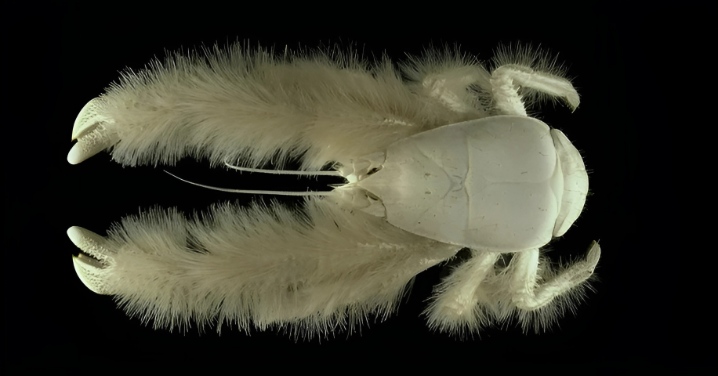
There are animals that charm you, animals that terrify you, and then there are animals that make you stare into the middle distance and rethink how life even works. Enter the yeti crab, a pale, hairy-armed crustacean that lives in the deep sea where light gives up and chemistry takes over. This creature looks like a plush toy that wandered into a volcano and decided to start a farm. It has no interest in your surface-world fussing about salad and sunshine. It is busy waving its bristled claws over vents that belch out toxic fluids, grooming a crop of bacteria on those silky fibres, and then eating the harvest like a very patient, very fluffy farmer.
The first one popped up on scientists’ screens in 2005 during a dive near the Pacific-Antarctic Ridge, south of Easter Island. Its legs were covered in pale yellow hairs, its eyes were reduced, and its vibe was a cross between ghostly and endearing. The crew nicknamed it the yeti crab, because sometimes even scientists embrace the obvious. And with that, a new cult favourite of the deep sea was born.
To get why the yeti crab is so weird, you need a quick tour of its neighbourhood. Hydrothermal vents are places where seawater packs into the seafloor, heats up on magma, and then bolts back out loaded with minerals and chemicals. There is no sunlight down there, so photosynthesis cannot help you. Life hacks the problem by shifting from sunlight to chemistry. Microbes take the sulphides and methane and turn them into food, and entire ecosystems bloom around these chemical factories. Imagine an orchard that runs on fumes and fire instead of sunbeams. That is the stage where the yeti crab struts in, brushes out its fabulous arm-fur, and starts farming.
The poster child that started it all is Kiwa hirsuta, the original yeti crab. It is not large, about the size of your hand, but those luminous, feathery setae on its legs are unforgettable. You will see plenty of people call it a crab, which is fine for headlines, although pedants will note that it sits with the squat lobsters in the anomuran club, closer to hermit crabs than to true crabs. If you are picturing a proper crab scuttle, adjust your expectations. Anomurans carry their bodies a little differently and tuck their abdomens in other ways. In the deep sea, the rules relax, and the family tree gets creative.
Then there is the species that made biologists grin and reach for more coffee: Kiwa puravida, found off Costa Rica. This one is not just hairy, it is choreographic. It waves its claws in the chemical-rich flow like a gardener fanning compost. On those claws, dense forests of microbes bloom. The crab then uses comb-like bristles near the mouth to rake off the bacterial lawn and eat it. Lipid fingerprints and isotope evidence confirmed what everyone suspected: the bacteria are not garnish, they are the main course. It is farming, plain and elegant, and it happens a thousand metres down in the dark.
If you prefer your yeti crabs with a pop-culture nickname, meet Kiwa tyleri, also known as the Hoff crab. It lives on Antarctic vents and sports a famously hairy chest, hence the name. Watch them stack themselves on vent chimneys like commuters jostling for a warm spot, each body placed just so in a knife-edge gradient between water that is scalding and water that is freezing. Too close to the vent and you cook. Too far and you chill. K. tyleri seems trapped by that thermal boundary for most of its life, which is both dramatic and slightly tragic. Females loaded with eggs bail out to the colder deep sea to release larvae that would not survive the cosy vent temperatures, a risky commute in a place built to punish optimists.
All of this looks bonkers until you remember the fuel source. Vents and seeps are chemical buffets. The microbes that colonise those hair-forests on yeti claws can oxidise sulphide or methane, turning poison into lunch. The crab is basically wearing edible sleeves grown by symbionts. It cultivates them with airflow, it harvests them with careful combing, and in doing so it outsources digestion to a team of specialists plastered to its own body. If you have ever kept a sourdough starter alive, you are already emotionally halfway to understanding a yeti crab. The difference is that the starter is on your counter, and the crab’s starter is sprayed across a pair of moving arms that it waves like a patient fan.
Let us gently correct a few popular myths. First, the hairs are not hair. They are setae, chitinous bristles that give bacteria somewhere to cling. Second, the glow is not bioluminescence from the crab itself. The drama comes from the vent landscape and the shimmer of heat, not from the animal twinkling like a Christmas bauble. Third, while the first yeti crab became famous for looking soft and benign, these are still deep-sea crustaceans with claws that mean business. The cuteness is a trick of colour and fluff. And lastly, although many headlines refer to them as blind, what they generally have are reduced eyes adapted to darkness. If you live in a place where noon tastes like midnight, you stop investing in fancy cameras and let your microbes do the sensing and feeding.
It is impossible to talk about yeti crabs and not talk about beauty. Not the postcard kind. The beauty of a solution that looks absurd until you step back. The yeti’s lifestyle is a triumph of minimalism and partnership. It finds a flow of chemicals. It raises its flag of setae. It waves, it waits, it eats. That is a spare script for survival, but the choreography is exact. On Antarctic chimneys K. tyleri forms living blankets, the chest gardens pressed to the sweet spot where chemistry hums. At Costa Rican seeps K. puravida cycles its claw-fans like a metronome, fertilising its crop and raking breakfast with efficient little motions. These behaviours are not showy. They are meticulous. They are how you turn geothermal breath into body mass, and they are why the phrase “not natural” deserves a long vacation. Nature plays jazz. The yeti crab is improvisation made flesh.
And here’s where pop culture joined the fun. In 2015, SpongeBob SquarePants aired an episode called Yeti Krabs. Mr. Krabs tells SpongeBob and Squidward a scary story about a monster crab covered in fur that punishes lazy workers. At first it’s just a tale to scare his staff into working harder, until—of course—the real Yeti Krab shows up. A shaggy, pink-and-white brute waddles into Bikini Bottom, eyes bulging and claws snapping. Squidward is convinced it’s just Mr. Krabs in costume until the beast’s appetite for Krabby Patties proves otherwise. SpongeBob, true to form, ends up saving the day not by fighting, but by cooking—the Yeti Krab just wanted burgers. It’s a perfect cartoon echo of the real yeti crab: misunderstood, hairy, and ultimately just looking for a meal. Nature and SpongeBob somehow landed on the same joke.
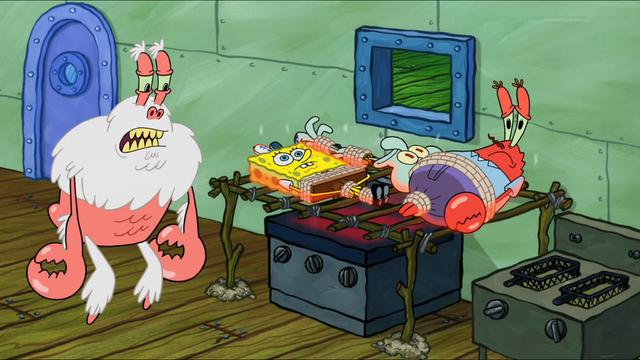
And this is where we wave at those grumbling voices that love to declare what counts as natural. The yeti crab hears you, and then remembers that it farms food on its arms, raises a crop of bacteria using sulphide and methane, lives on a chimney that hisses like a tea kettle from the underworld, and even stars in a SpongeBob parody. If natural means neat, tidy, and identical, the ocean has a polite request for you to sit down. The world is a festival of exceptions that work. Hairy-armed gardening at the bottom of the sea—and a cartoon cameo in Bikini Bottom—should settle the debate.
If you strip away the novelty, what remains is a quietly radical idea. Life does not need light. Give it a gradient, a trickle of chemicals, a scaffold to hold the right microbes, and it will make a living in places that feel like the planet trying to say no. The yeti crab belongs to that idea. It is a little white punctuation mark at the bottom of the world, saying yes. Yes to partnerships that look improbable. Yes to engineering solutions that double as fashion. Yes to the patience of waving and waiting. Yes to a food web written by microbes that never see the sun. And yes to a future in which we learn to treat places we barely understand with the care they obviously deserve.
You may never see one in person. Most of us will meet them in short clips, pale shapes fanning invisible currents on chimneys rimed with metals. That is fine. The point is not to tick them off a list. The point is to hold the idea in your head that life is inventive beyond whatever rules you memorised in school. Somewhere, right now, a yeti crab is raking breakfast off its own arms. Somewhere, a female is slipping away from a warm spire to release eggs in safer cold, then braving a return to a house that could cook her. Somewhere, a scientist is squinting at a graph that proves the waving speed changed when the flow shifted by a hair’s breadth. And somewhere, a SpongeBob rerun is reminding kids that even the scariest monsters are sometimes just hungry.
If you want a moral, take this simple one. Let the world be strange. Let it be messy and precise at the same time. Let a crab that is not quite a crab grow lunch on its sleeves and teach us that agriculture was not our invention, only our version. Let a family discovered twenty years ago remind us that discovery is still possible and that humility is still useful. And when someone tells you nature does not do that, remember the yeti crab—and its SpongeBob cousin—and smile. It has been doing that for a long time. We only just learned to look.